Projects

Solidworks Connected 2025 Failed to Install Troubleshooting

I use Solidworks Connected Makers edition to do a lot of my 3D Modeling. I had used Fusion 360 in the past, but they kept changing the license and what file types you could export, so I moved to Solidworks. As many posts from the community say, sometimes it’s like the company is trying to make you mad. Every year or so we get the next update, that you have to do because it’s a web-connected (for no reason) platform; and somehow the install breaks and won’t work. I spent a sometime trying to find all the different bits to delete to get it to install properly and wanted to document it. Once you get Solidworks in working order, it works well. It’s getting it there that is difficult.

I had a failed install, the Solidworks site thought the application was installed, but when I clicked run, I got “failed to launch application, not found”. I uninstalled anything related to Solidworks or Dassault Systemes. Then I found and deleted the following.

Files:

  • C:\Program Files\Dassault Systemes\SOLIDWORKS 3DEXPERIENCE
  • %appdata%\SOLIDWORKS
  • %appdata%\DassaultSystemes
  • C:\ProgramData\DassaultSystemes
  • C:\ProgramData\SOLIDWORKS

Registry:

  • Go to HKEY_LOCAL_MACHINE\SOFTWARE\Microsoft\Windows\CurrentVersion\Installer\UserData
    • Search for “Solidworks”, I found items like \S-1-5-18\Products\0911033B9E8C8E647ABE3D57D2083CB1\InstallProperties, where DisplayName was “Solidworks 2020”, delete anything related to Solidworks at the Products level.
  • Delete “HKEY_LOCAL_MACHINE\SOFTWARE\Dassault Systemes”
  • Delete “HKEY_LOCAL_MACHINE\SOFTWARE\SolidWorks”
  • Delete “HKEY_CURRENT_USER\SOFTWARE\Dassault Systemes”
  • Delete “HKEY_CURRENT_USER\SOFTWARE\SolidWorks”

Even in the best conditions, on a fast machine it will take a LONG time to install, 3+ hours, looking like nothing is happening, I left it overnight. The x MB/y MB installed will not always progress for a while.

Logs in: C:\Program Files\Dassault Systemes\SOLIDWORKS 3DEXPERIENCE\InstallData\log

The install seems to install 4.5 billion MSI files, and then after each runs “.NET Optimization Service”; if your install is progressing, that service should periodically jump in CPU usage. My install halted at 76% 6122MB/14942MB installed for a long time; again, I left it overnight and it managed to finish.

I hope this helps someone. If others have issues or fixes, please leave a comment; maybe together we can get this program to work. In the end, mine worked after being left overnight, and now everything is functioning well with the 2025 release.

Update:

I went to reinstall and got the following errors:

Failed to get msi version for UpgradeCode [{B54313C8-7B46-297F-3AC1-85D9EFD5ECB7}].

Technical details:
The property is unrecognized
Error code: 1608
Invalid data in HKEY_LOCAL_MACHINE\SOFTWARE\Microsoft\Windows\CurrentVersion\Installer\UserData\S-1-5-18\Products\BE85C2B02A76B522062B1D99E055DD33
Action CheckInstalledMsiVersionAction from feature CODE\win_b64\SWXDesktopInsPreqWPT failed.
Action ID: SWXDesktopInsWPTInstalledAction

Failed to get msi version for UpgradeCode [{00F50064-7000-11D3-8CFE-1050048383C9}].

Technical details:
The property is unrecognized
Error code: 1608
Invalid data in HKEY_LOCAL_MACHINE\SOFTWARE\Microsoft\Windows\CurrentVersion\Installer\UserData\S-1-5-18\Products\E5A00A437891E38418011307471668D7
Action CheckInstalledMsiVersionAction from feature CODE\win_b64\SWXDesktopInsPreqVBA71 failed.
Action ID: SWXDesktopInsVBA71InstalledAction

I ended up searching for those hashes in the registry, “BE85C2B02A76B522062B1D99E055DD33“, and “E5A00A437891E38418011307471668D7“. Then deleting registry keys where a sub part mentioned Dassault Systems. After that I could progress with the install. Again, this seems to happen if you had Solidworks 2020 installed at any point.

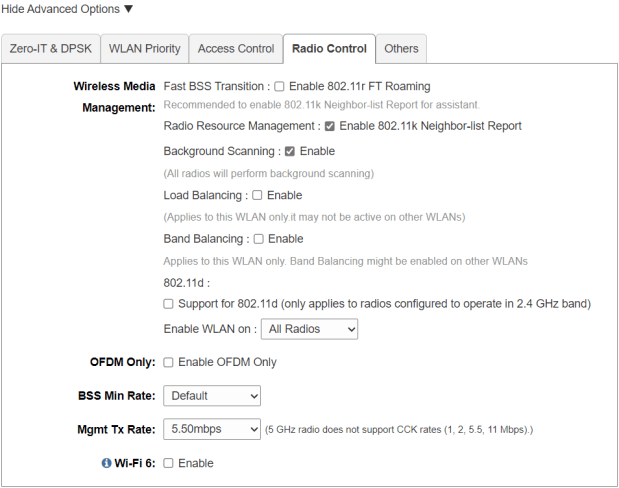
Improve WiFi Roaming by Adjusting DTIM Settings

My original version of this post I put together over a year ago. I was having issues with a 4 AP Ruckus Unleashed network I have in my house. I thought the issue came from 1 of the access points (APs) being WiFi 6(AX), and the rest being WiFi 5(AC); I wrote the post about disabling WiFi 6 on the 1 AP, then wanted to see if my issue were resolved over the next week. It was not. The issue was mostly around Apple devices refusing to roam. You can walk far away from 1 AP, and towards another, and you wouldn’t roam for a LONG time without manually disabling and enabling WiFi.

After more digging, and seeing people online chat, I was pointed to an Apple post (which has since disappeared) saying to move your “WiFi DTIM to 3”. DTIM (delivery traffic indication message) handles how often an access point echos out information about itself.

Changing this setting has seemed to make roaming on Ruckus work much better. Ironically, or not, this is one of those settings network engineers argue about. Here is a different Apple support post saying it HAS to be 1. Cisco, says the value should always be a 1 or a 2. Hopefully this info helps someone else if they are having issues, give it a try.

Shadow Box

I enjoy working on projects that can mix a bit of art with tech/electronics. I was playing around with the idea of doing something with a shadow box which could go up on the wall. Something to do with lighting and an ESP32 came to mind. The eventual goal was to get the ESP32 onto the Wi-Fi, allowing you to control the lights and mode of a device from your phone and perhaps HomeKit. I got part of the way there, adding a button to change modes; but then I got off on another project as I am to do. I wanted to document my progress, and state for later; as well as put the code and designs up online before I go off and work on a more ambitious project. 

General Design

I started playing around with 3D designs, so that a light could shine through; the designs were really 2D, but I used SolidWorks to do all the modeling, then adjusted the heights until the light came through well. I glanced around online at artwork people had, as well as periodically looking at Dribbble.com. I came around to the idea of a skyline; a city at night where the different buildings could light up, and blink. Then the idea added on; the buildings could blink to music, adding a microphone onto the controller would allow the lights to reflect the volume of audio. 

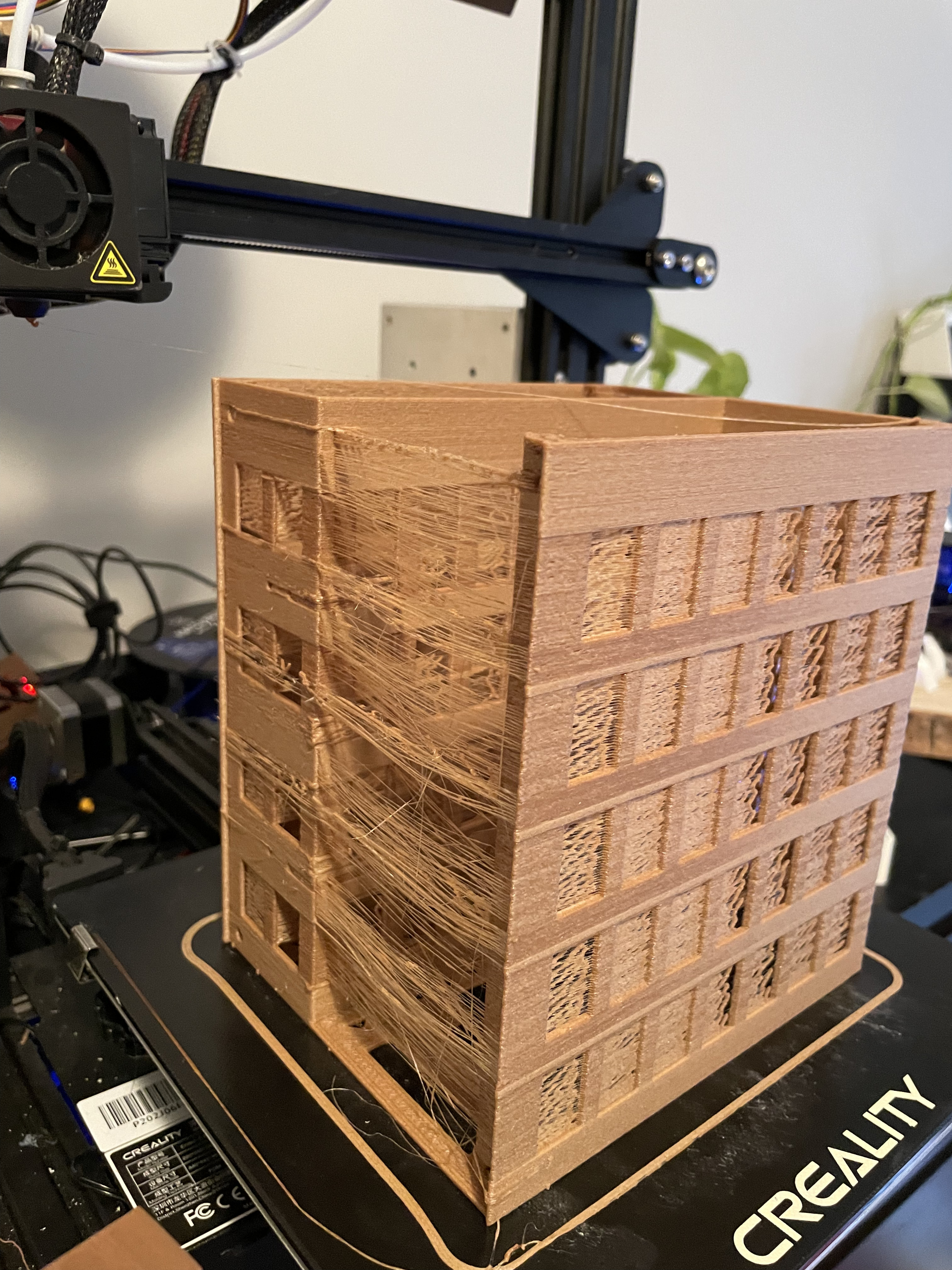
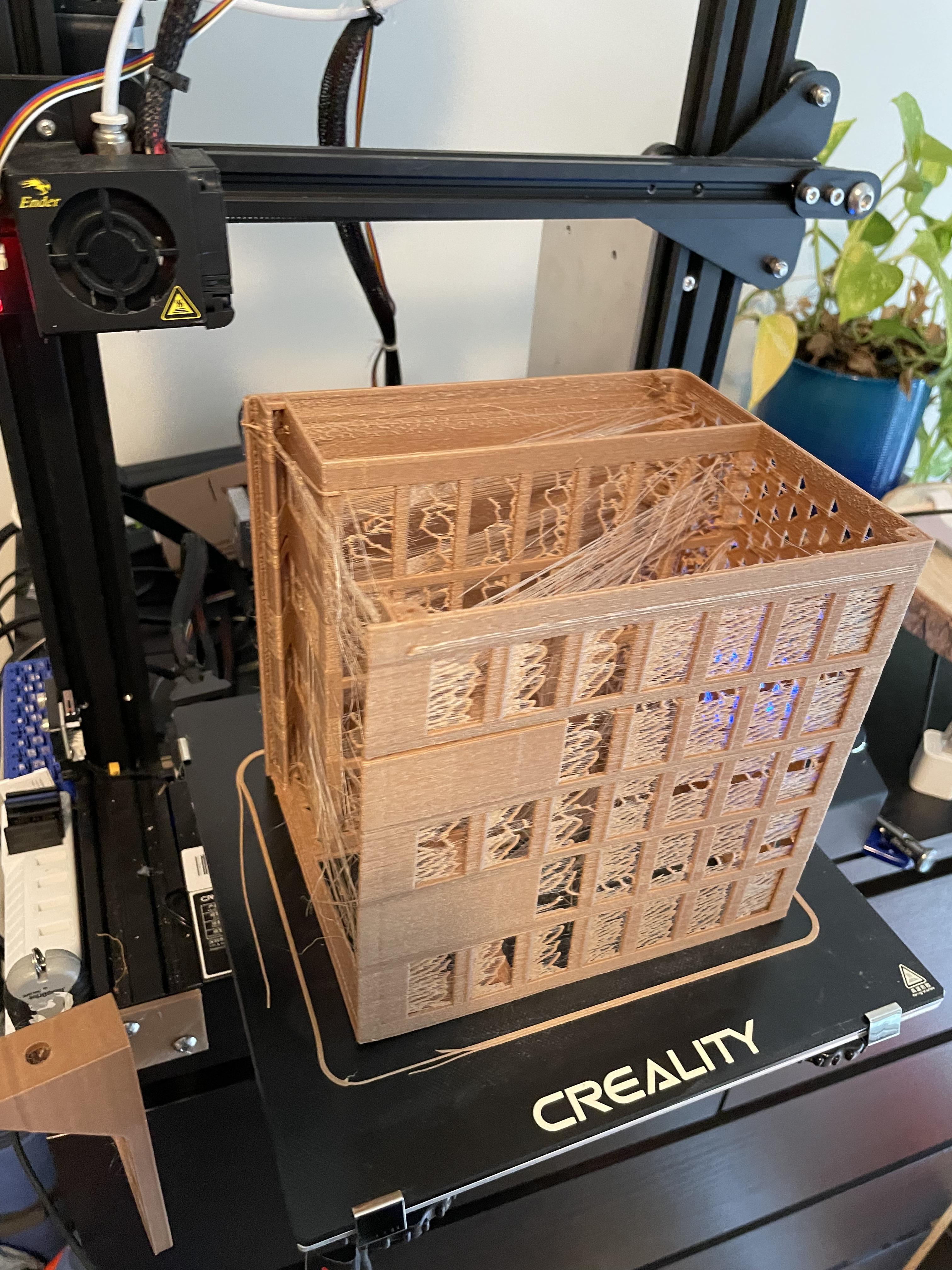
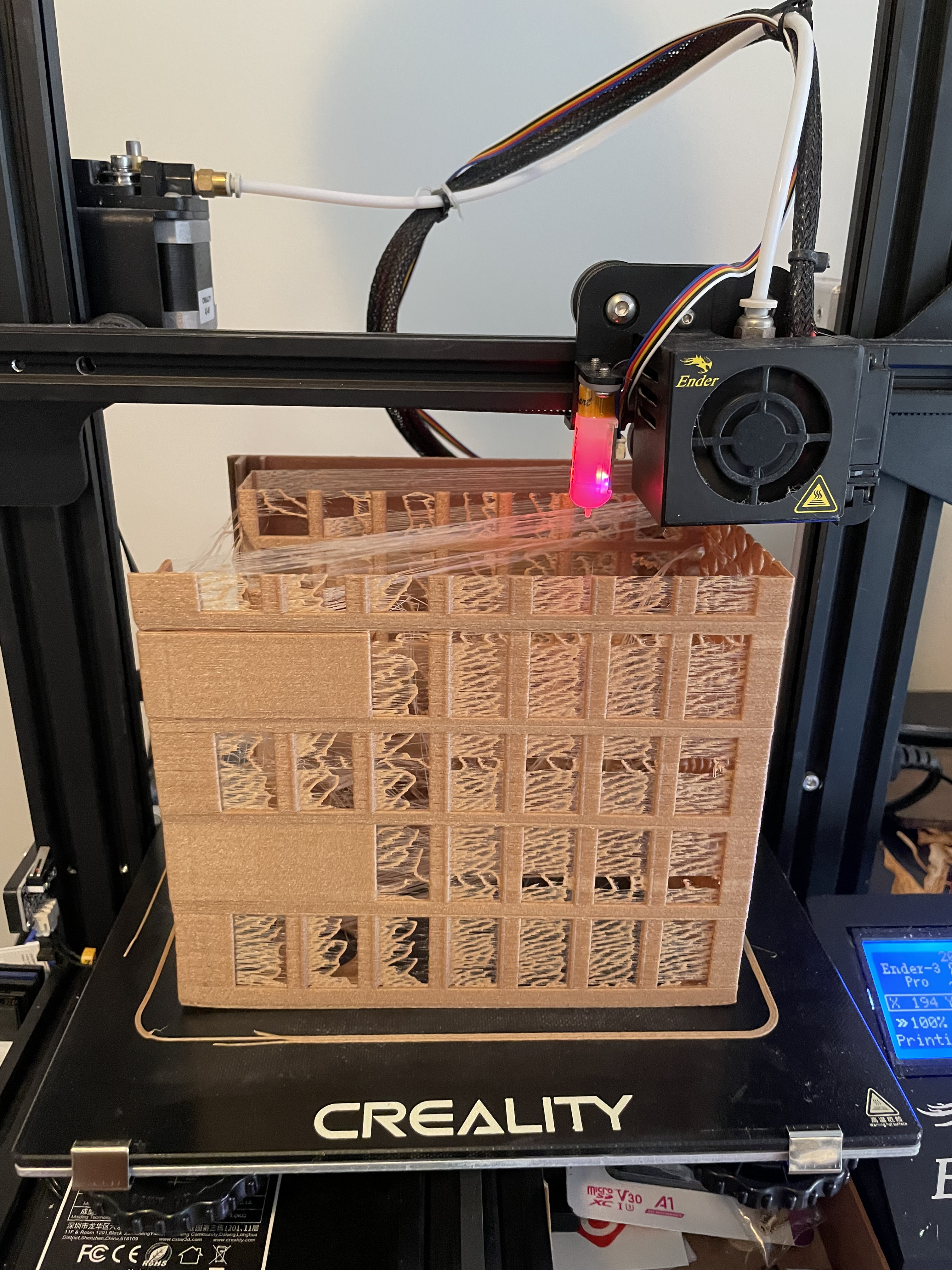
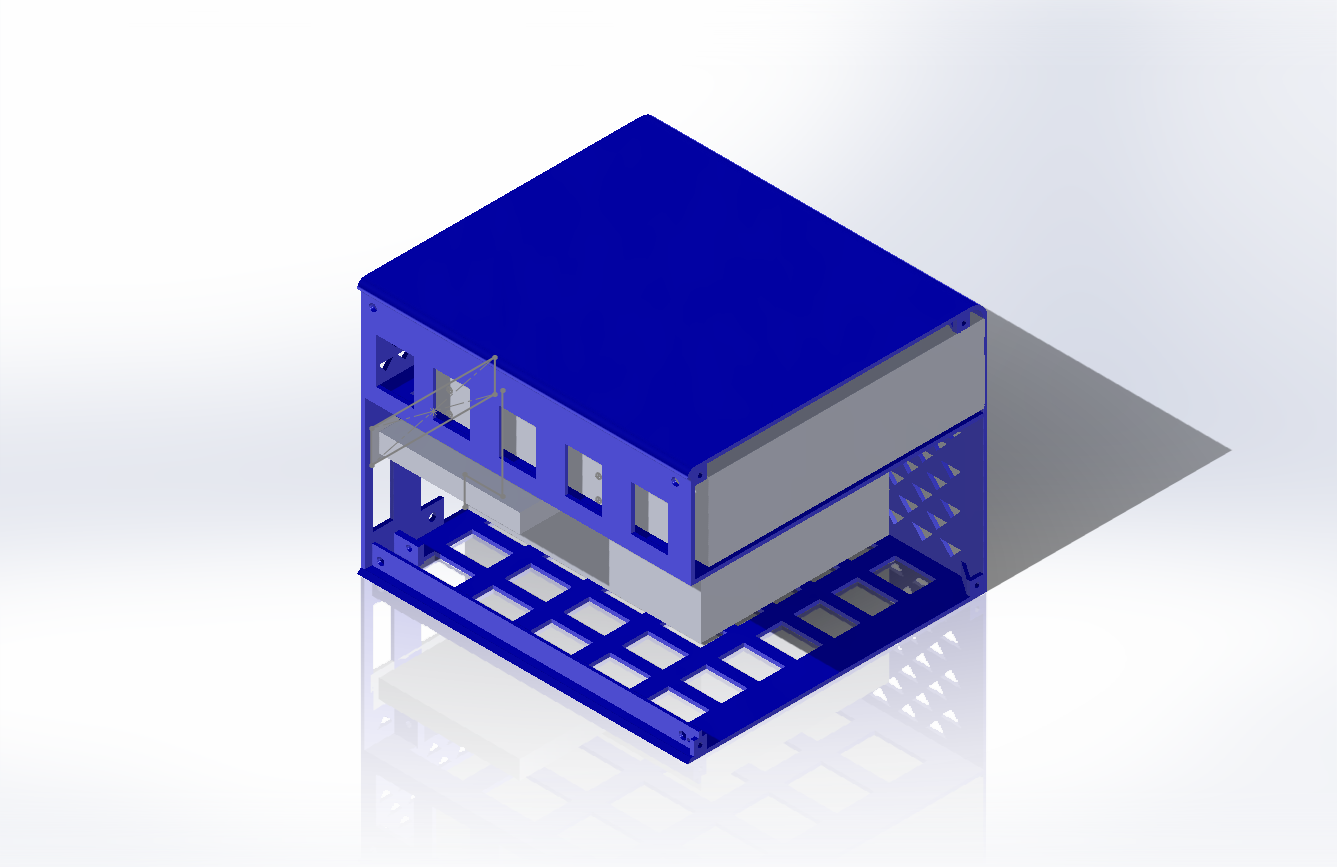
I at first tried to print out individual, large, buildings and this proved to be too much and take a very long time. If you look at some of the below early renders, you can see how complex those buildings are.

I decided on the New York city skyline and started modeling the buildings. I needed a mix of decent sized windows, so the 3D print did not take forever; and small enough that the light effect came across well. I modeled several buildings, a few different ways, and did test prints. A few times I printed them taller than the printer could go, and that made me split the buildings in half. I did not like how putting them back together looked and decided to shrink the buildings a bit. I currently have a Creality Ender 3 Pro, making my bed size roughly 200mmx200mm.

Electronics

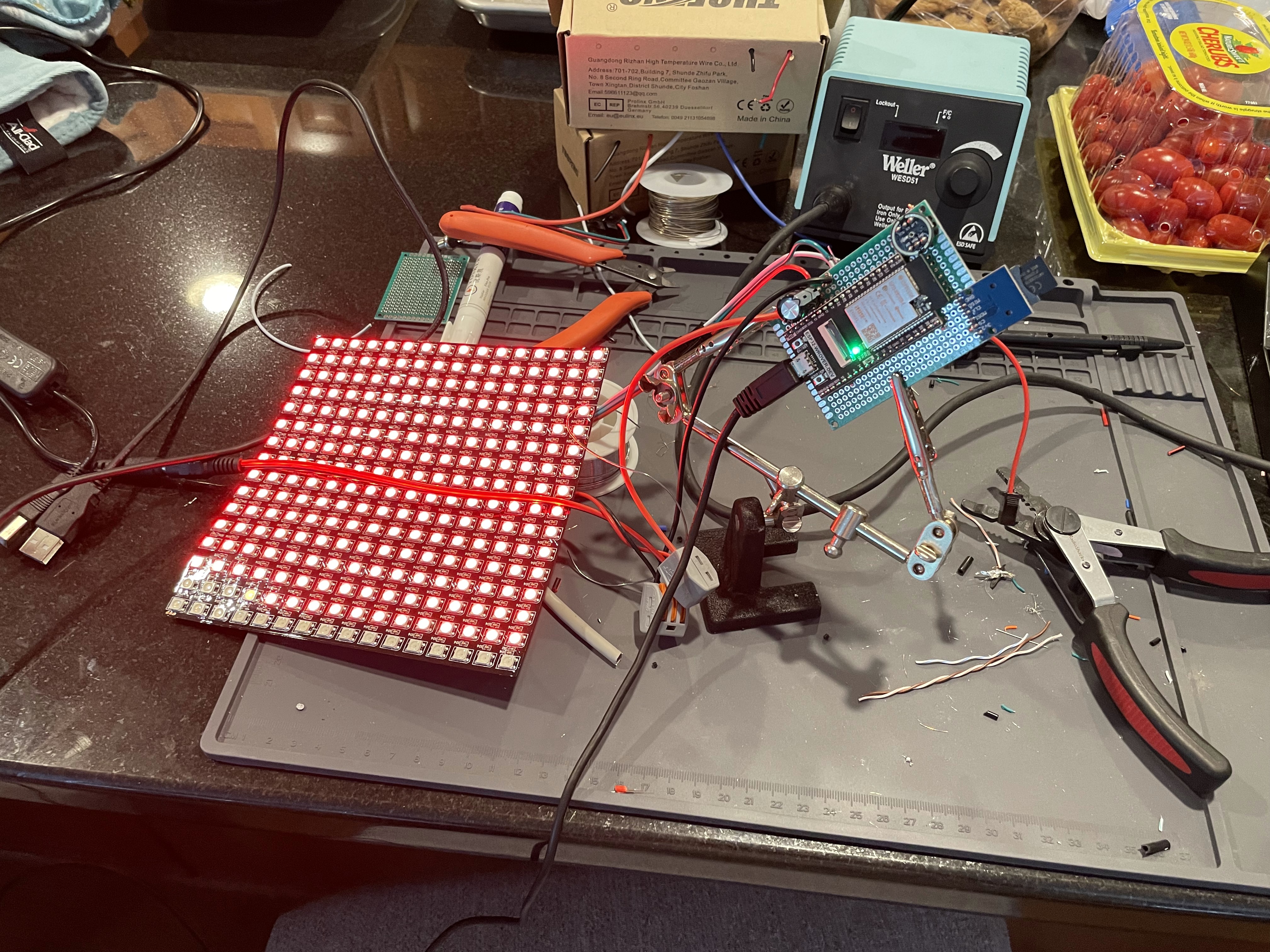
The plan was always to use an ESP32; I had not used them before and for a few dollars getting the capability to use the Arduino IDE along with Wi-Fi and Bluetooth made me interested. I also had not done much with LED strips before either. I dabbled with both on my workbench, and decided for this purpose an LED grid would be easier than working with strips. Those can be had for a few dollars online. I also got a diffusion sheet, a thick sheet of plastic that softens the light from the LED. 

I worked on the Arduino code for a little while. I ended up writing a bit of code that averages the volume over time from the tiny microphone I hooked up to the ESP32, and then uses that to equate to a light level on the LED grid. The different columns in the grid matched different frequency ranges; this ended up giving a neat lighting effect with distinct types of music triggering different buildings. I need to calm it down a bit, but I didn’t put enough time into the code to get it exactly where I want it. Another code the box offers currently does a much much slower fade across the LED grid, but its sensitivity is too low, and the only way I got it to react was tapping the box; this can be seen in the video below.

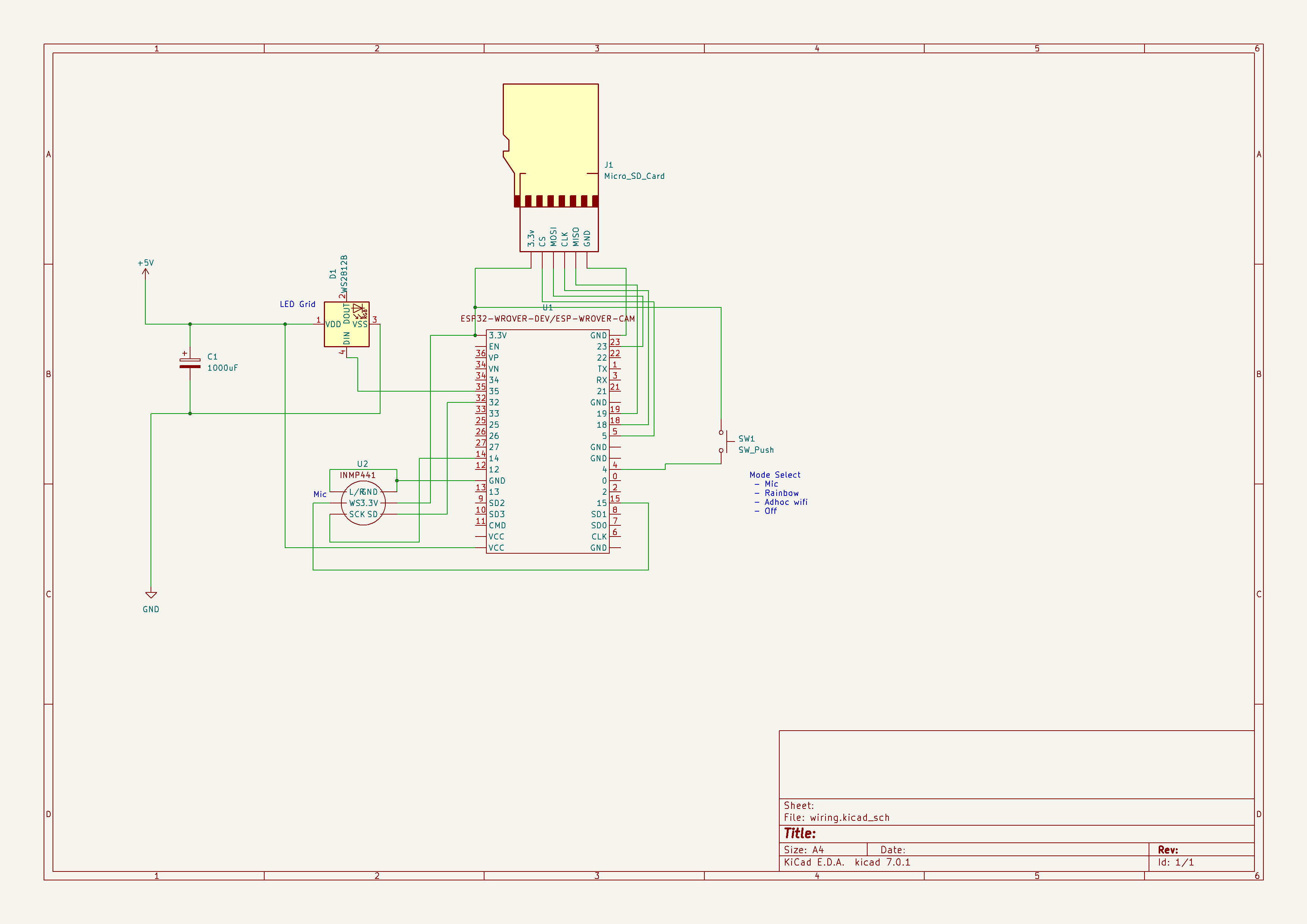
I also used this as an opportunity to use KiCad for my wiring diagrams. The diagrams for this are not that complex, but I wanted to be able to quickly reference what went where. All these files are in the Github for the project. There is a button on the side of the box which cycles modes the system is in. There is an always on light, a mode to go to the music/audio in the room, slow light effects from audio (but not sensitive to the mic enough), and last was going to be a Wi-Fi mode (but I never got that working). I was going to mount an SD card for longer storage of assets for the Wi-Fi network; with the Wi-Fi not being implemented, this needed up not being needed, but a good learning experience.

Wiring diagram

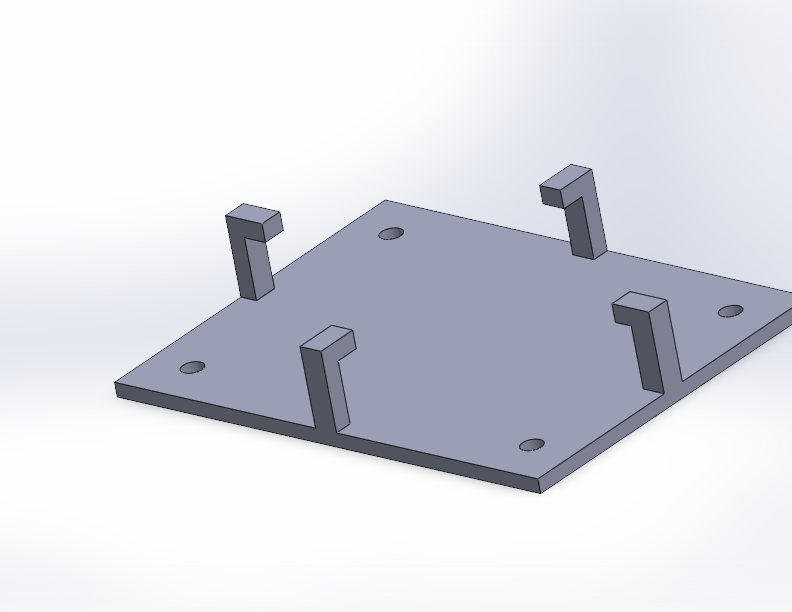
There were small issues along the way, like how I wanted to make a power bus come in, and 3D printing little risers to hold everything off the back of the shadow box enough to get a good effect through the front window. Those were slowly overcome, mostly by trial and error, and I worked through the project. I fed the whole thing from a 5V wall plug. This would give power to the LED grid, and the ESP32. 

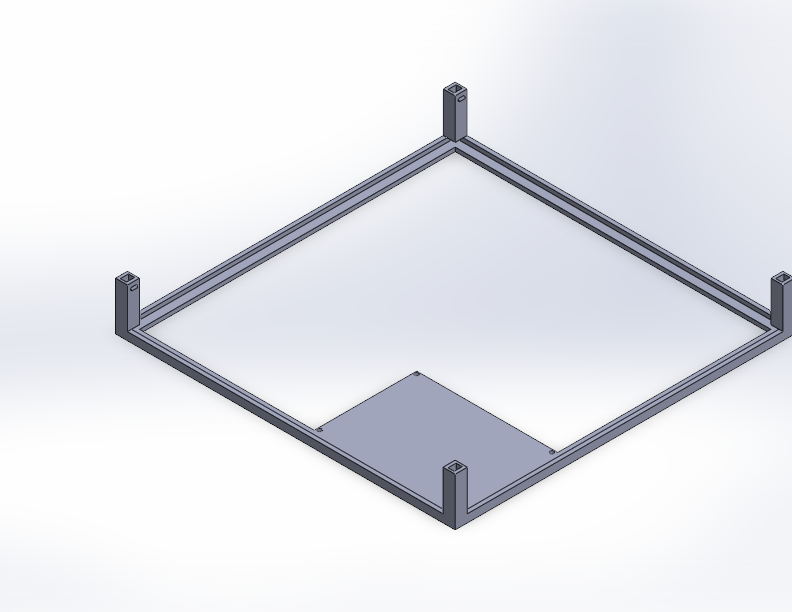
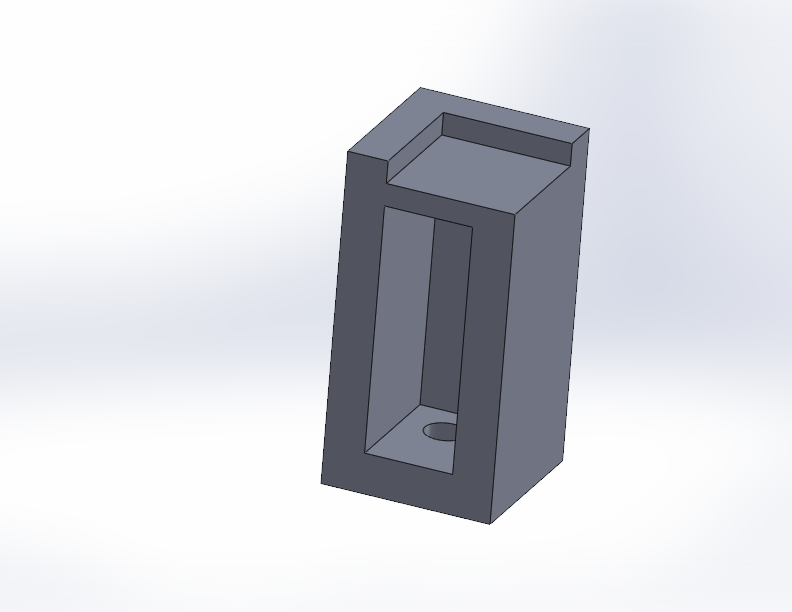
I ended up simplifying the building models to speed up prints, and it generally looked nicer. The bigger windows were easier to print, and the effect functioned better. I attempted to make a mount for the LED light grid, that would have a front snap onto it to lock in the grid. I at first made the mounts too small for this, then got lazy and used hot glue over pushing forward small snapping plastic pieces.

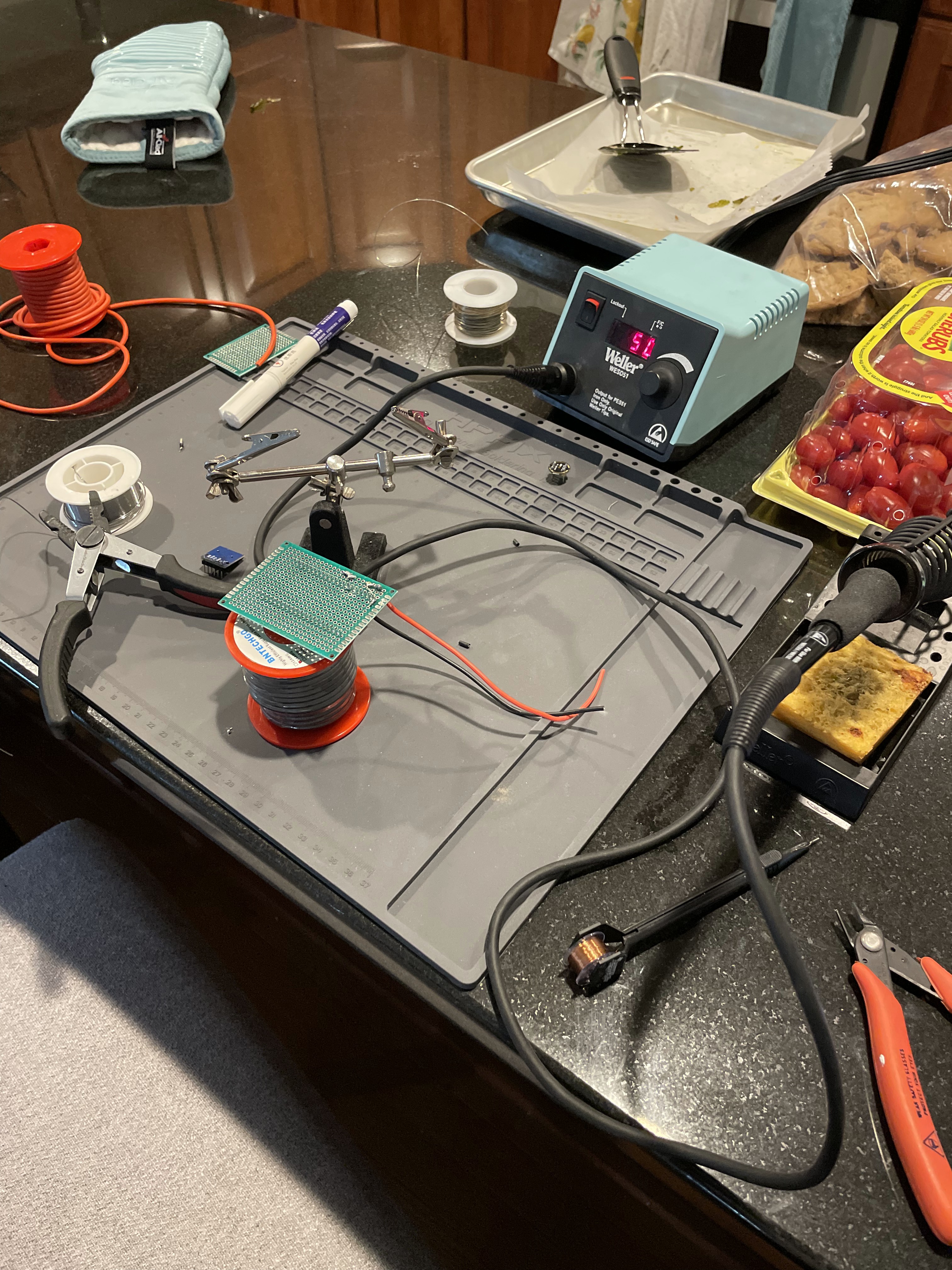
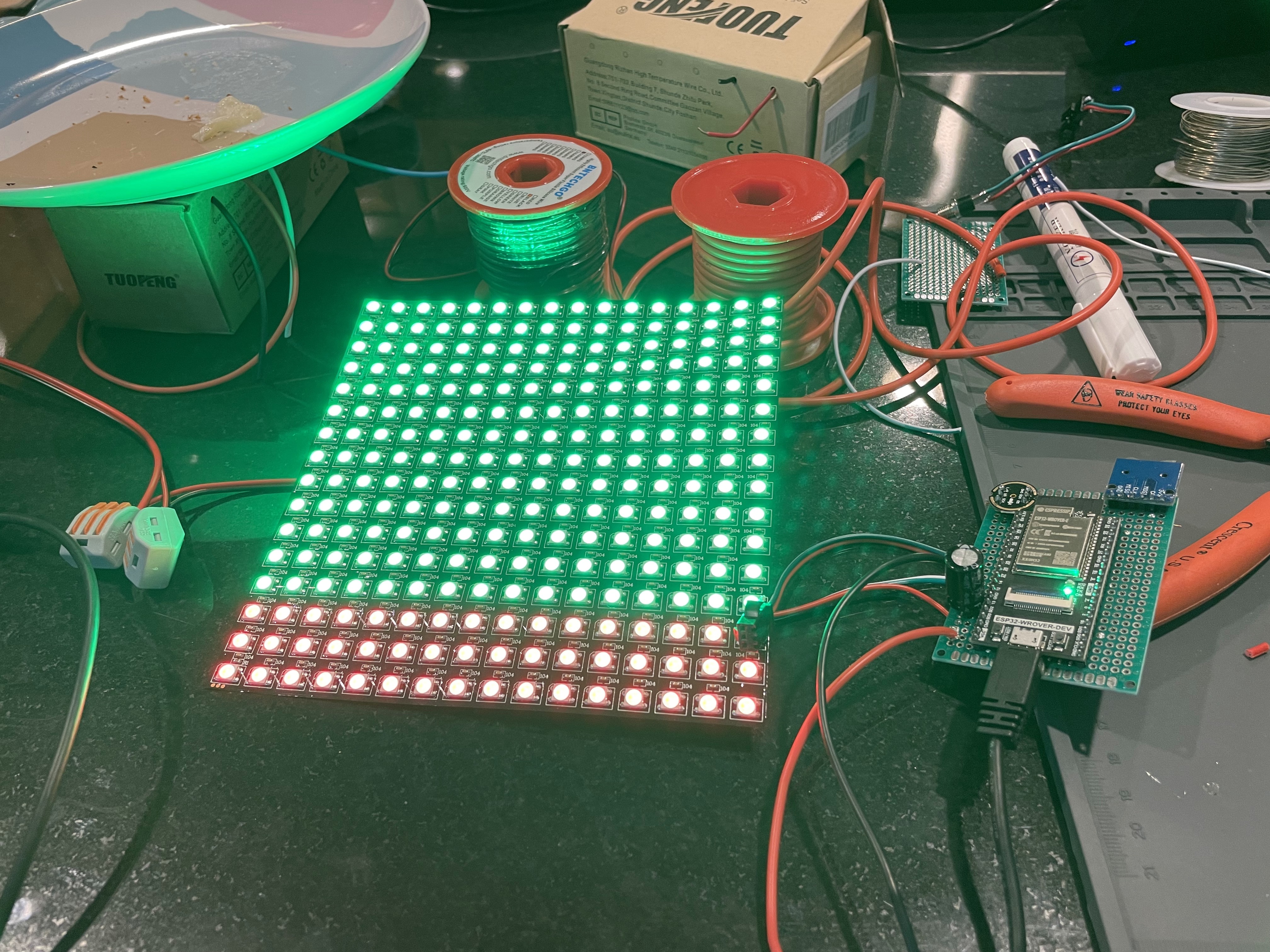
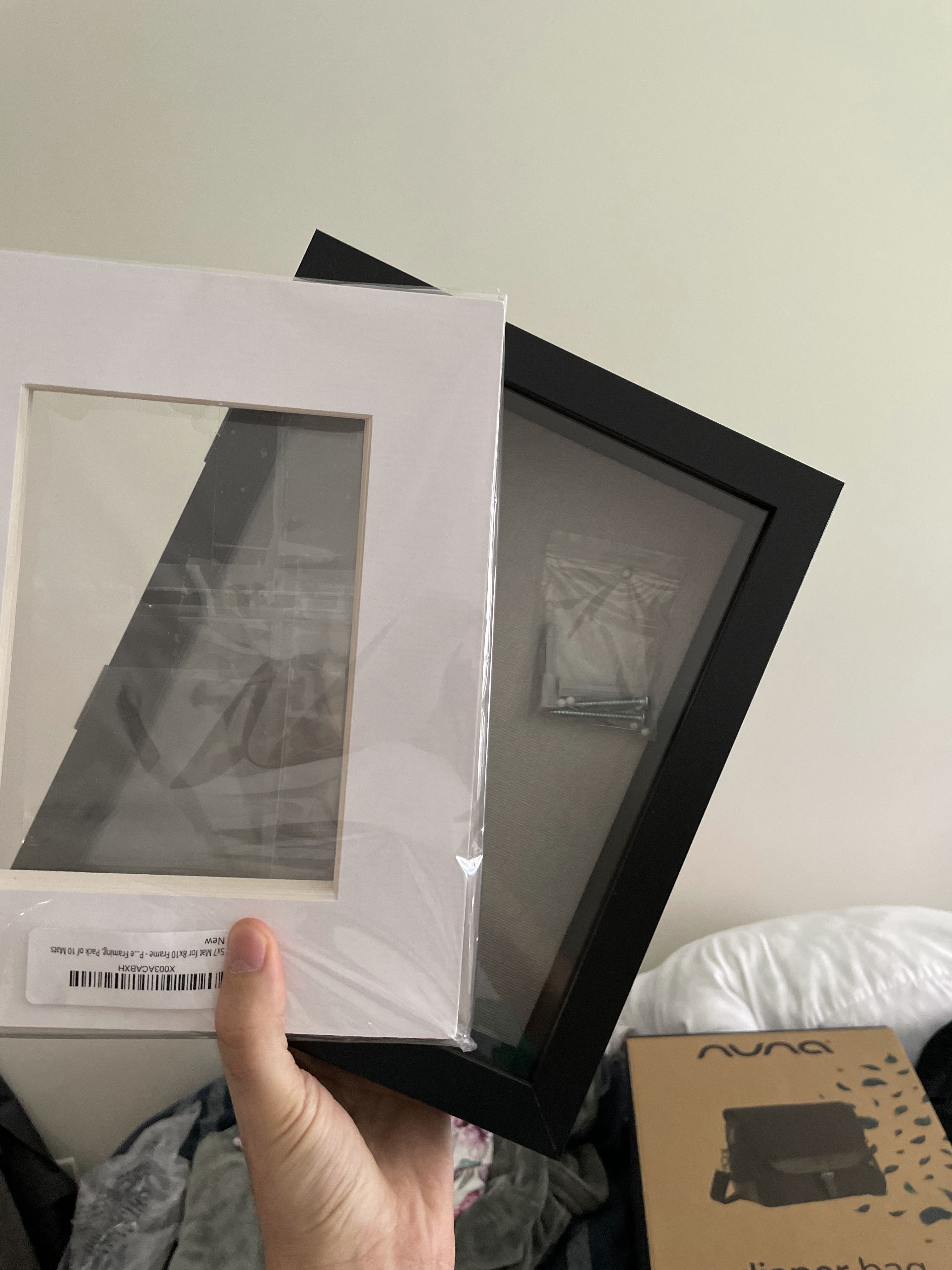
In the end, I think the project came out well. I thought I may make more of them, for different cities, and then have a wall of them; and get the controller to the point where you could Wi-Fi control it. Except I have another project idea that has taken me away. Perhaps I will one day return to this, until then here is a video of it running (actually 3 videos spliced together), and the files will be on Github. I don’t have a ton of photos from putting it together, but here are a few.

Github: https://github.com/daberkow/shadow-box

Parts Used (I am not including things like wire, or little common parts):

Button – https://www.amazon.com/dp/B07KX24WWS

Microphone – https://www.amazon.com/dp/B092HWW4RS

Mat – https://www.amazon.com/dp/B00BN1XIR2

Diffusion film – https://www.amazon.com/dp/B09XGZP71S

Shadow Box (8×10) – https://www.amazon.com/dp/B08V5RR6D5

LED Grid – https://www.amazon.com/dp/B09KB7WC75

ESP32 – https://www.amazon.com/dp/B0B3JD1K1T

Mellanox SX6012 Homelab Upgrade

For the last few years, I have been using a Mikrotik CRS309-1G-8S+. A small, low power, 8 port, 10gb/s switch. It worked well for me. One of the main things I liked about it was the low power usage. There are always discussions on different homelab forums about which switch to use. Some people like to use Arista or Cisco gear. I enjoy that gear and use it at work, but with my small and low power homelab an Arista switch would triple my power usage (a lot of them idle at 200-300 watts). There are nice features on those switches, but to get those nice features they have whole small computers as the management plane, and then power-hungry chips for switching.

The time came where I wanted to upgrade past this small Mikrotik switch. 8x10gb/s ports were great for a while, but 1 was uplink to the home core switch; then with running vSAN, I wanted 2 ports per host, and I have 4 hosts. While not urgent, I started to search for a bigger switch. Mikrotik has some bigger offerings, also low power, but a lot of the offerings were $400-$600+ to go to 12+ 10gb/s ports.

One place I like to browse periodically is the ServeTheHome forums. There homelab users talk about many different homelab things including networking. Many users seem to be interested in the Mellanox SX6012 or SX6036. This switch is discontinued from Mellanox (now Nvidia) making them go for fairly inexpensive on eBay.

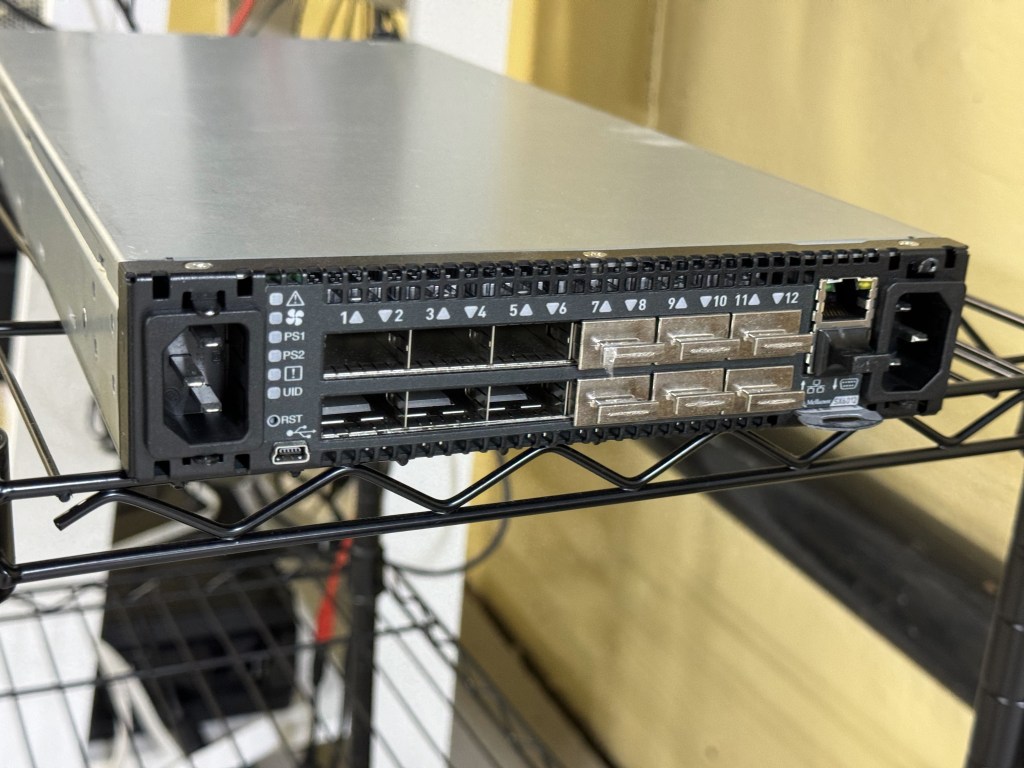
The SX6012 is a 12 port, 40gb/s switch; capable of using 40gb break out cables. That means each 40gb/s port can be 4x10gb/s ports. The switch is technically an Infiniband switch, which can get an optional Ethernet license. There are some switches sold with the license, along with guides online to enable that part of the switch. Apparently, there are also people on eBay who can “assist you” in licensing the switch for $50. Being the switch is no longer supported, I think a lot of the eBay buyers are homelab people going through the guided process of configuring the switch with a license. The switch was reported to be “not that loud”, which is true after some fan setting tweaks; and also idles at 30 watts from a low power PowerPC chip. This made it a go to for me. Plenty of ports to upgrade to over time, and a low power budget.

In looking at the switch, one thing that was heavily mentioned are the different editions of it. There are 12 and 36 port versions, along with Mellanox vs other OEM sub branded versions. For example, you can get a Dell/EMC Branded switch which will come with different features than a HPe switch, or a Mellanox themselves branded on. I wanted the 12-port version because (in theory according to online) it had slightly lower power draw. The 36-port version is supposed to be a big quieter (having more room to cool), but I also saw some firmware hacks to lower the fan noise. I saw one SX6012 unit which had the black front bezel (apparently that makes it Mellanox Brand) sitting on eBay with an expensive Buy It Now, or Make Offer. While they still go for around $250, I gave an offer for a good amount lower, and they took it! Score!

Flash forward a few days; I got the switch from the seller, powered it up, and was met with a dreaded bootloader… The OS had been wiped from the switch completely… along with everything on the flash. After a brief moment of dread, I thought about finding one of the guides online for managing these switches. Those guides are not just about enabling features like Ethernet, they are there to show you how to load different firmware revisions and where to currently find it. The Mellanox firmware itself was behind a support portal which got folded into Nvidia. Although these switches were also sold under Dell/EMC/HP brands, and some of those brands still provide the firmware packages. There are community scripts which can take in a HP firmware package and convert it to a Mellanox or other brand firmware package.

Mellanox port mgmt

After a slow TFTP image load, I got the switch online. This allowed be to get a GUI and more easily load the follow up firmware packages. After many reboots (which can be heard throughout the house with the fans ramping to 100%), and a few upgrades later I had the switch in a good place at the last available firmware for it. For the last several months the switch has quietly been working well for me. I have one QSFP to SFP+ adapter for the 10GB from my core switch coming in. Then I have 2 QSFP -> SFP+ break out cables going to the small cluster I am running. This means I am running on this one switch, without high availability right now. If I want to reboot or patch the switch, I need to shut down my VMware cluster. One benefit to an out of support switch without firmware updates… You have no firmware updates to do!

The CLI is similar to Cisco. Like many other switch vendors, they seem to follow a similarly universal CLI. The hardest part of getting the switch going for me was figuring out the command to set the QSFP port to breakout mode. Once that was done, it creates 4 virtual sub-ports which you configure with vlans and such. The UI showed the ports as single ports, even with the breakout cable until I went in the CLI and set it to breakout mode.

With this switch working well, I moved the old 8x10gb/s Mikrotik switch over to be my new 10gb core switch. The current flow is Internet in -> Sophos XG Firewall on a Dell Optiplex 5050 -> Ruckus ICX7150 POE switch for Wifi and a few wired ports -> 8 port 10gb/s Mikrotik -> Mellanox SX6012. The house can run with just the firewall and Ruckus switch (which powers all the Wifi APs). The Mikrotik is near the router, and also allows a Cat5e run (19 meters) already in the wall to go up to the attic and give 10gb/s to a NAS and AP up there. (I know 10gb RJ45 is supposed to be Cat6, this line was run before I was here and tested fine, it has been working well the whole time) Then the Mikrotik switch has a SFP that does a longer fiber run to where my little homelab rack is. The whole system is a glorified “router on a stick” with the firewall doing all the routing between vlans.

This setup has been working well, has plenty of room for expansion, and achieved my goal of being fast with relatively low power use. I have the management for the switches on a disconnected vlan that only certain authenticated machines can connect to. This makes me feel better about its not getting security updates.

Mellanox at 29w

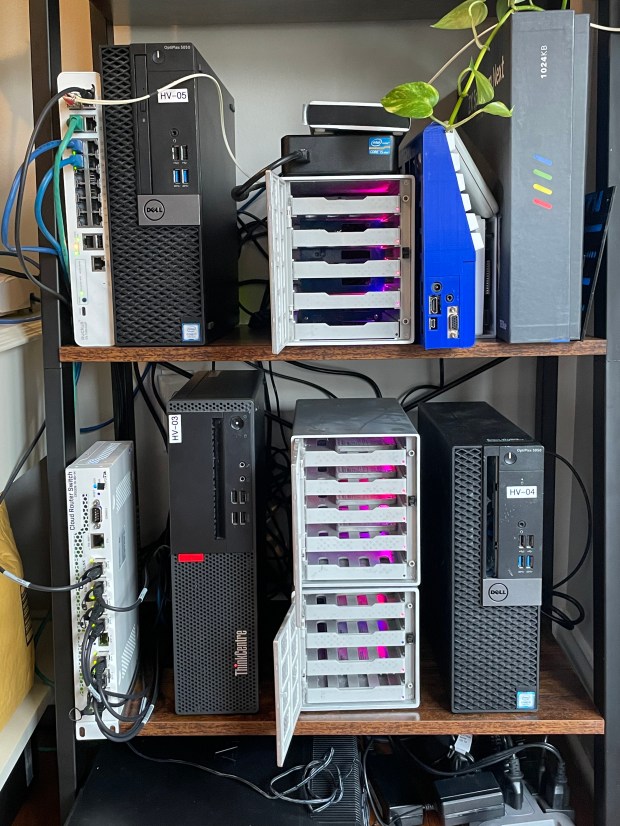
Currently I have 4 small Dell Optiplex systems as my homelab cluster along with the Mellanox switch. All together the rack idles around 130 watts. Together the systems have about 20 physical cores (not hyper threaded cores), and 288GB of RAM. It can certainly spike up if I start a bunch of heavy workloads, but I continue to find it very impressive.

Ruckus H510 Factory Reset

I have a Ruckus Unleashed Wi-Fi setup at home. I have a main R710 (AC Wave 2, 4×4:4) in the center of the house, then a H550 where my desktop is for better wireless and added hardwired connections. One corner of the home was getting only moderate signal and already had ethernet run to it; looking online, another H550 (Wi-Fi 6, 2×2:2) on eBay would run about $150. That was a bit more than I felt like spending to fill in this pocket with lower signal. In looking around the H510 (AC Wave 2, 2×2:2) has gone end of sale, but not end of support; those are currently going for $40.

Ruckus R710
Ruckus H550

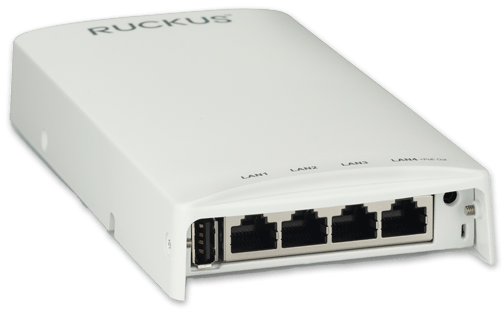
The Ruckus H510 and H550 are very similar, with the exception that the H550 is Wi-Fi 6. They are great little access points. Their range is not as good as the bigger units, and their sensitivity isn’t that high. They were designed for things like hotel rooms. But for filling in a space with Wi-fi and giving you 4 ethernet ports, each capable of having its over vlan or 802.1x.

Having already setup a H550 I figured this install with an existing cable and POE switch at the other end would be easy. The issue I ran into was I didn’t have the password and the unit refused to factory reset. The documentation said “Hold the Soft Reset Button for 8 seconds” that didn’t work. Elsewhere said “Hold both soft and hard reset buttons for 10 seconds” that didn’t work. Others said, “Hold soft reset for 30 seconds”, which also didn’t work.

In the end, in frustration, the thing that worked was hitting soft reset, which has the red status light come on, then for about 5 seconds I would keep tapping on and off the soft and hard resets. This worked like a charm. Suddenly the password was reset, and I could get in.

Generally, Ruckus Unleashed has been working well for me. There seems to be a bug where when a device restarts, SNMP does not come on even if set. I need to go into the admin panel, turn it off, then back on for SNMP to start responding. But for a home network, not a big deal. Over the holidays I had a bunch of family members over, we had 39 devices on the network at once, with over 1gb/hour being used, and everything worked well. If anyone has Ubiquiti and is tired of their controller and lack of power features, I recommend giving Ruckus Unleashed on used gear a try.

Ruckus Unleashed ICX Management Stuck at “Connecting”

I have a mostly Ruckus and Mikrotik network stack at home. For the longest time, Ruckus Unleashed has had the ability to manage ICX switches; but every time I went to add my switch to the Unleashed interface it would hang at “Connecting…”. After a bunch of troubleshooting, I figured out why it was not working.

Unleashed likes to automatically adopt blank switches, if your switch is already configured you may have the same issue. The issue is Unleashed cannot use a ICX switch with an enable password. I had to run:

SSH@switch(config)#no aaa authentication enable default radius local

Then suddenly if I ran “# show log” I could see Unleashed adding settings to the switch. Unleashed seems to use SSH as the main mechanism for setup, then adds a RO SNMP string to the switch. Hope this helps someone!

Homelab HCI Storage Adventures

I have written before about storage for my homelab. I have a NAS; and then for the VMware cluster, I had USB 3.0 attached 3.5″ hard drive bays. The hard drive bays shared a single USB 3.0 5 gbps connection. And being that storage has come down in price, these were SATA SSDs. Having (at the time) 4 SATA SSDs sharing a single USB 3.0 connection was not ideal; not only because of the single pipe, but because of the overhead of USB. When the vSAN these disks hit any more than idling IOPS number, latency would go through the roof. That was the main item I was attempting to correct.

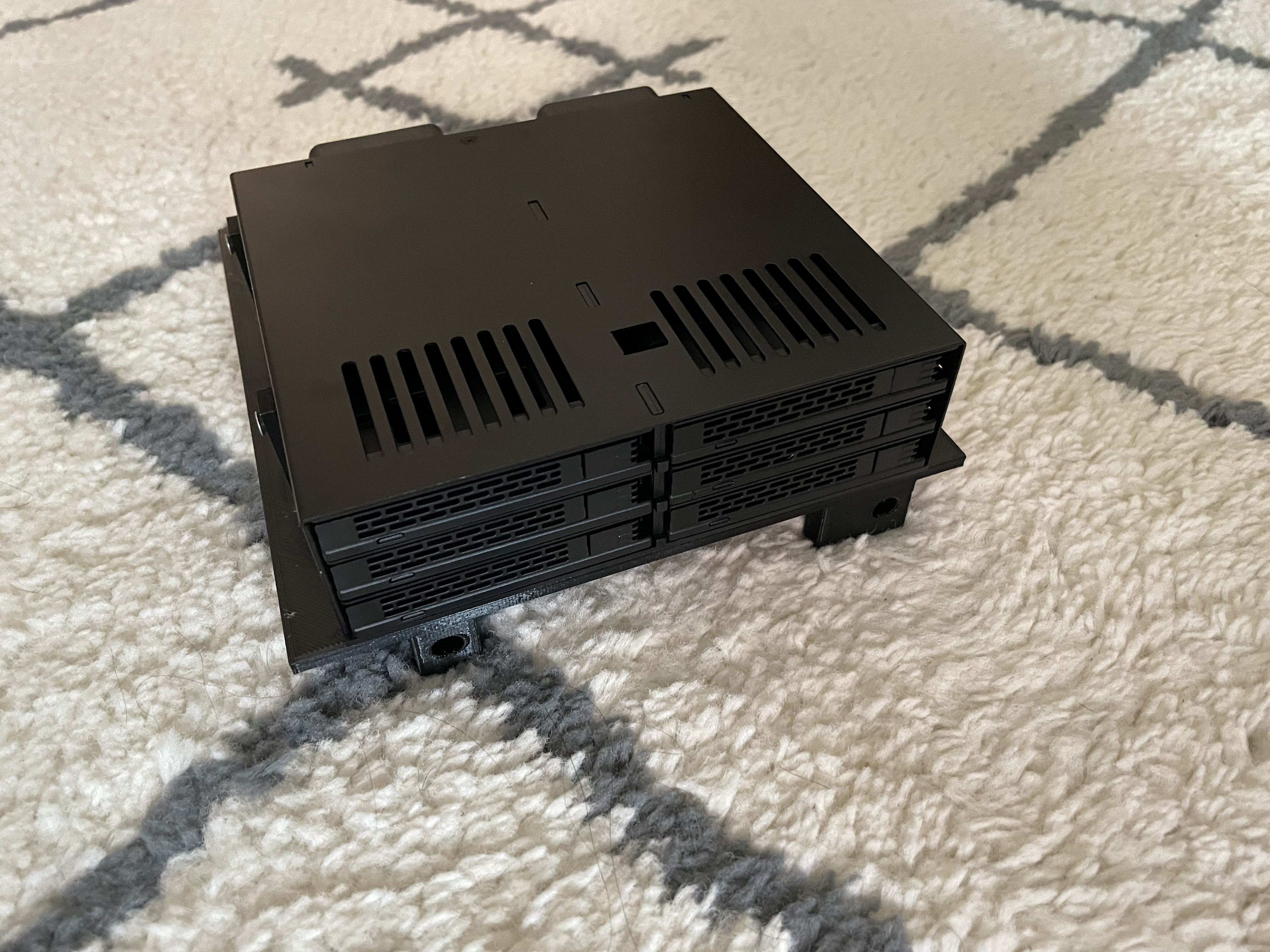
Having used “disk shelves” before at work, I thought I would try to make a compact version for my homelab. I figured, all I need is an away to connect the SSDs over external SAS, an eSAS HBA, and some power. This project ended up going on for far too long and ending with a much simpler solution.

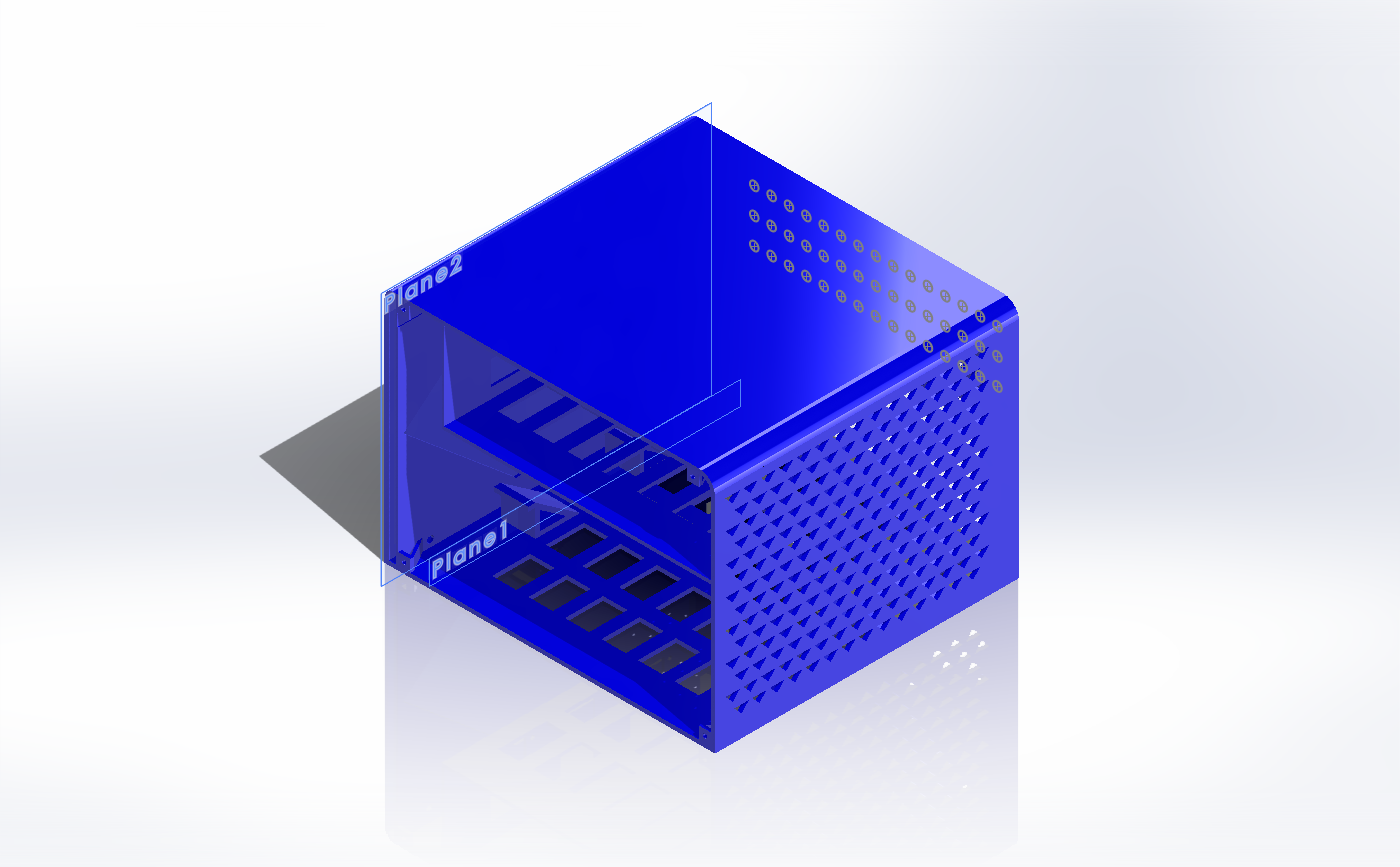
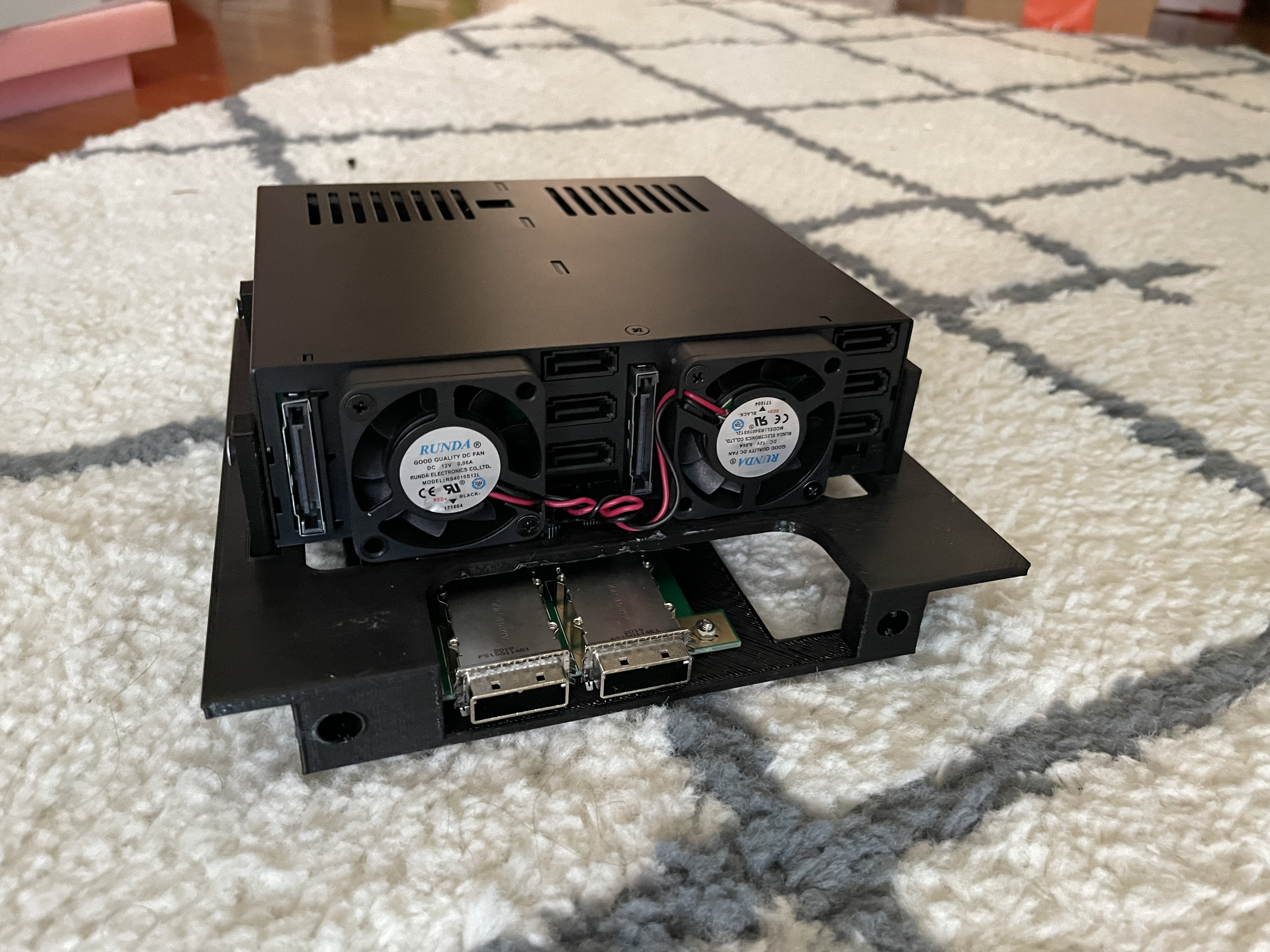
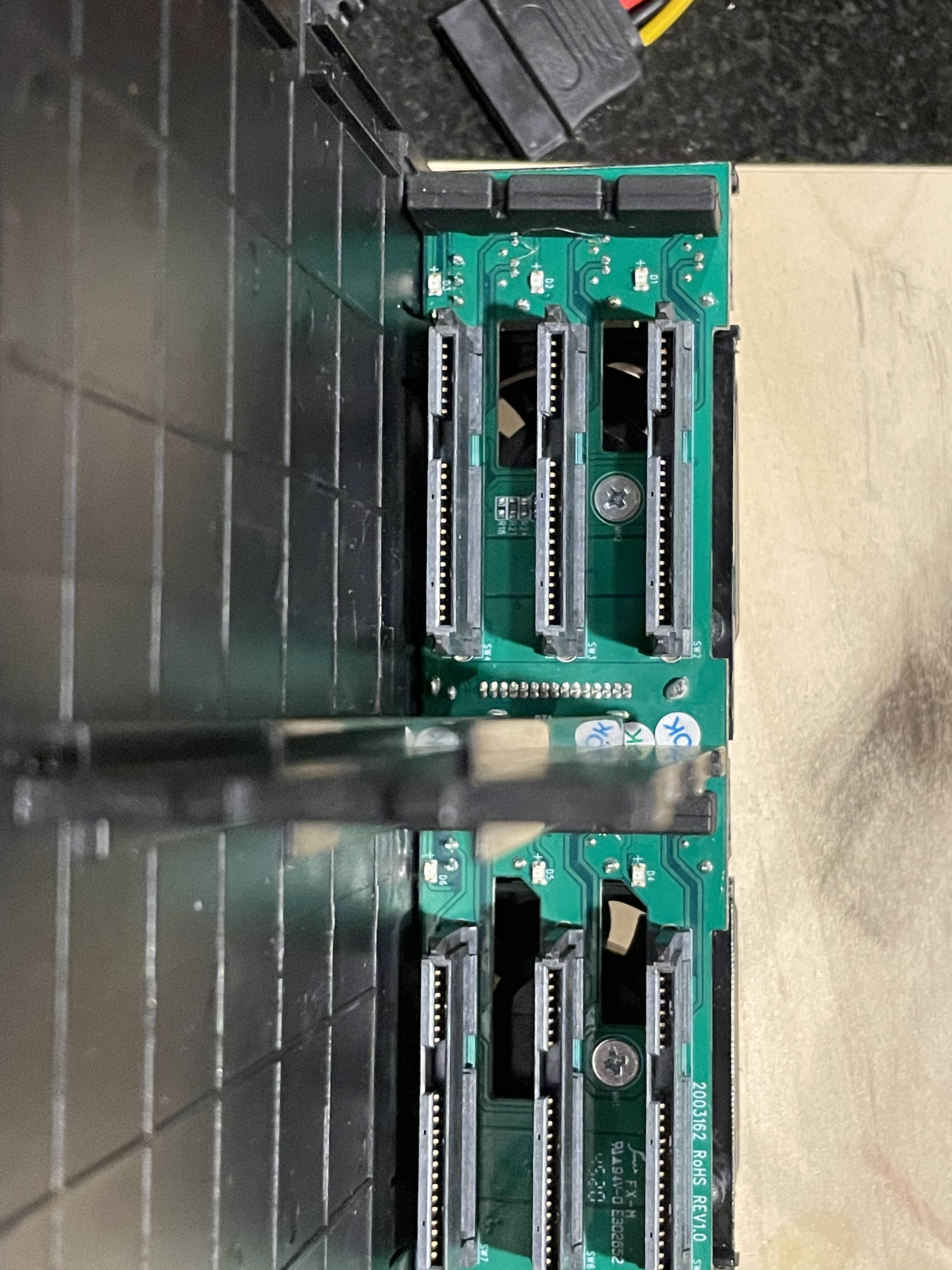
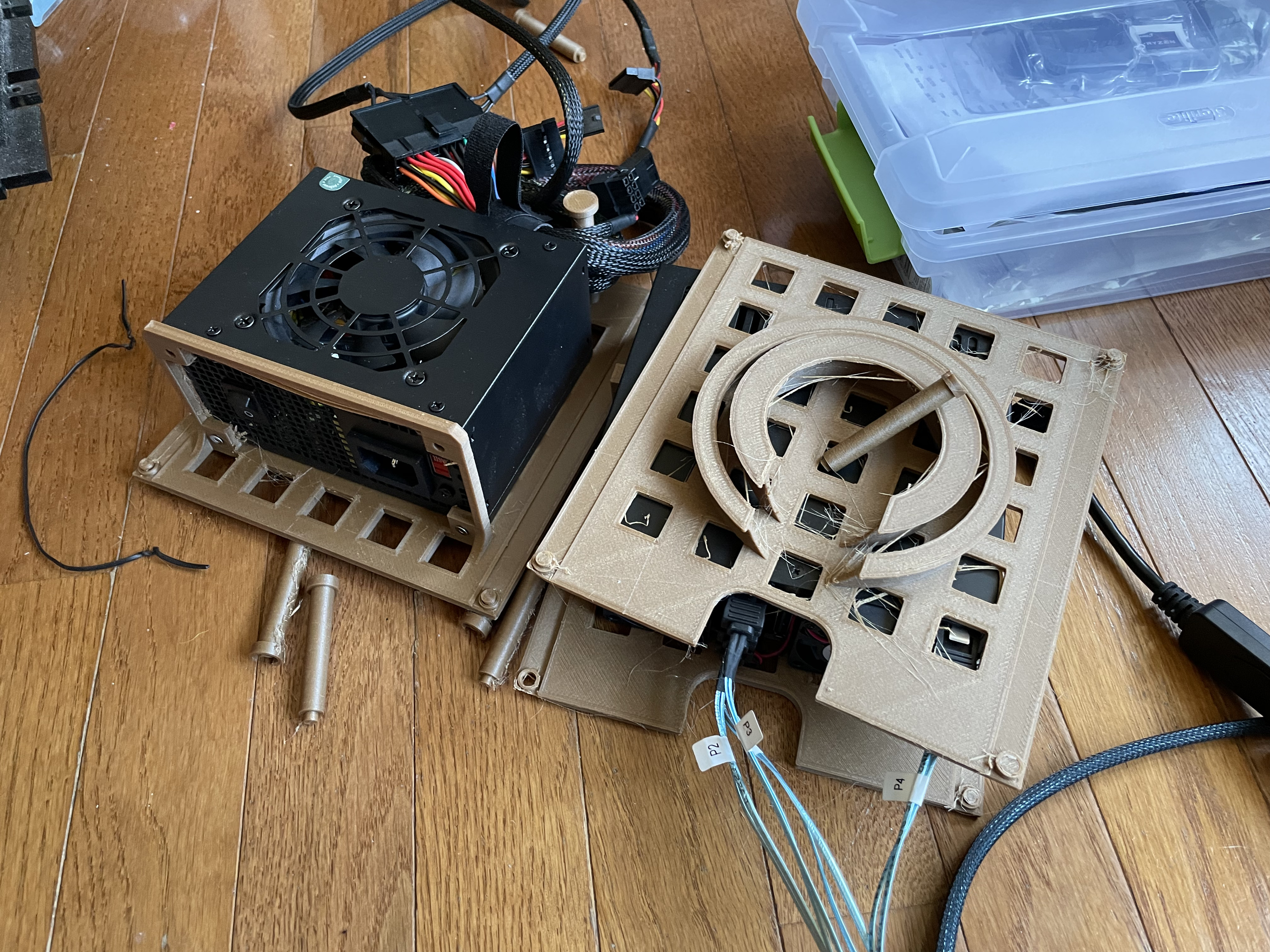
I started where any good project does, finding the general parts I will use for the project. I came across this adapter. It allows you to put 6, 2.5″ drives into a single 5.25″ DVD bay. Each drive gets its own SATA connection, and it even has fans on the back to cool them. I started designing the case around that. Then I found this little adapter to go from 2 internal SAS cables to external SAS. My thought was externally I would have eSAS into my “server”, and then convert that SAS to 4 SATA connections each.

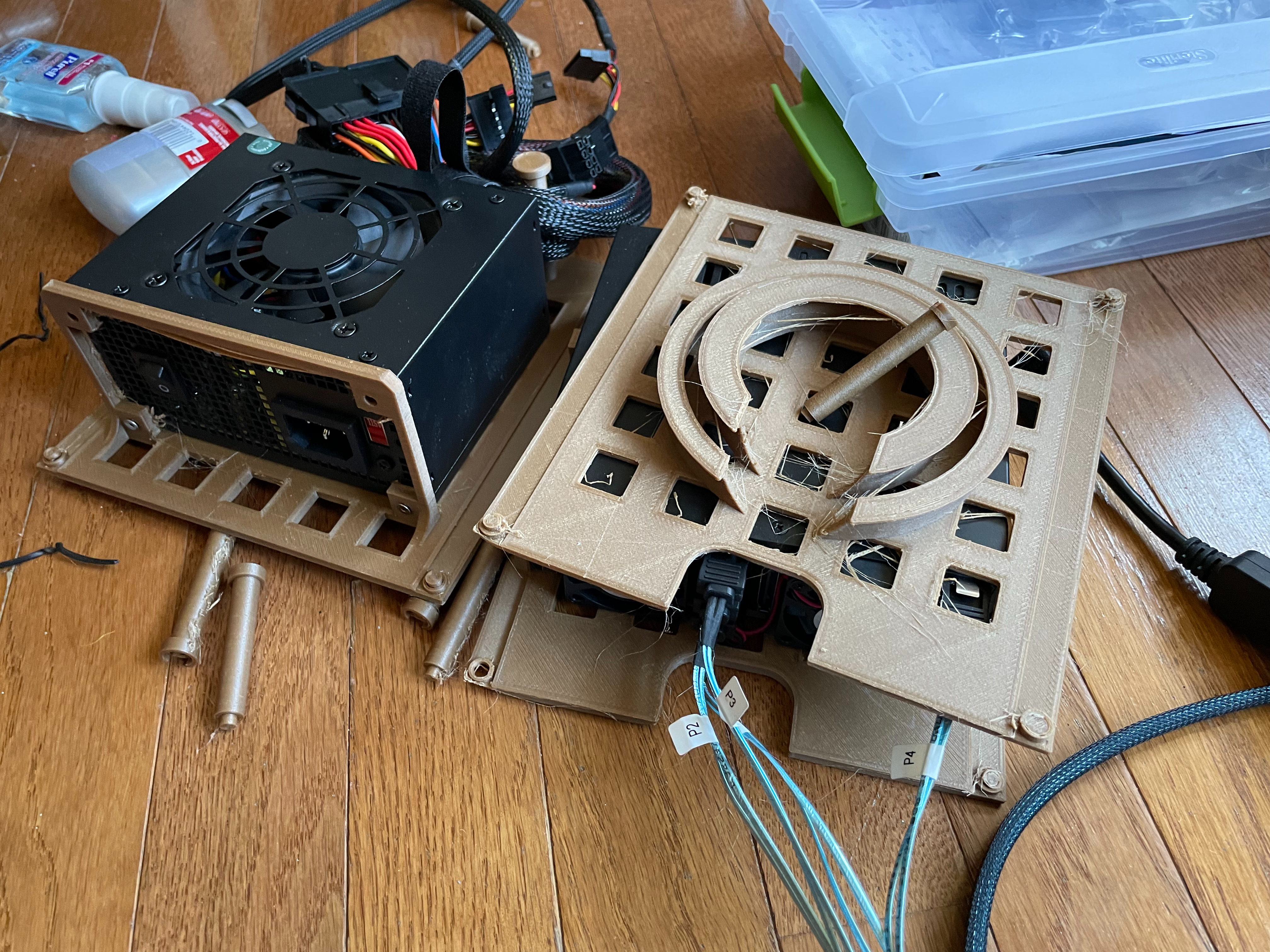
Now I needed to start creating a case to 3D print. Every other eSAS enclosure I found online was HUGE, I wanted something small that could fit the power supply, and the connections I needed. This went through many… many… iterations.

Some of the prints didn’t come out great; I spent some time getting the printer dialed in.

This was a bad path I went down; I was hoping to cut down the plastic and thought I could have levels and it stand on columns, this turned into much more of a mess (and hard to get to stay in the right position) than waiting for the bit prints to just finish.

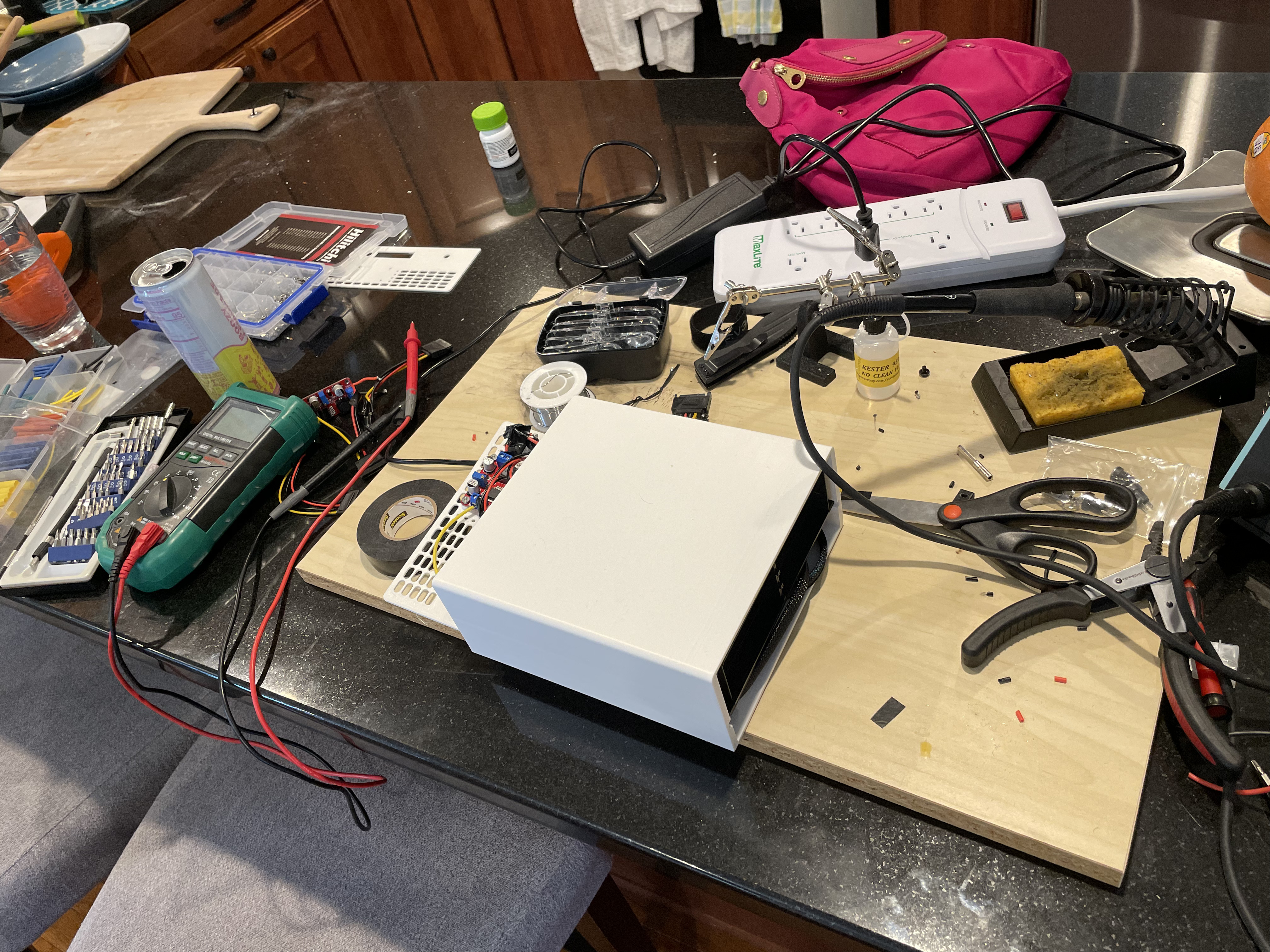
Next I had to figure out power. Each drive I had can pull up to 1.5 amps at 5 volts. This means I need 9 amps on 5 volts. That is a good amount of power on one rail. I thought I could use a standard PC power supply, with a cable to turn it on with a switch. These PSUs were big and made the design a bit bulkier. The next idea was to just use a wall power supply, a 5 volt one with enough amps. Also, I planned to only use the 4 drives per unit I had, so at least at first, I could cut the amp requirement down.

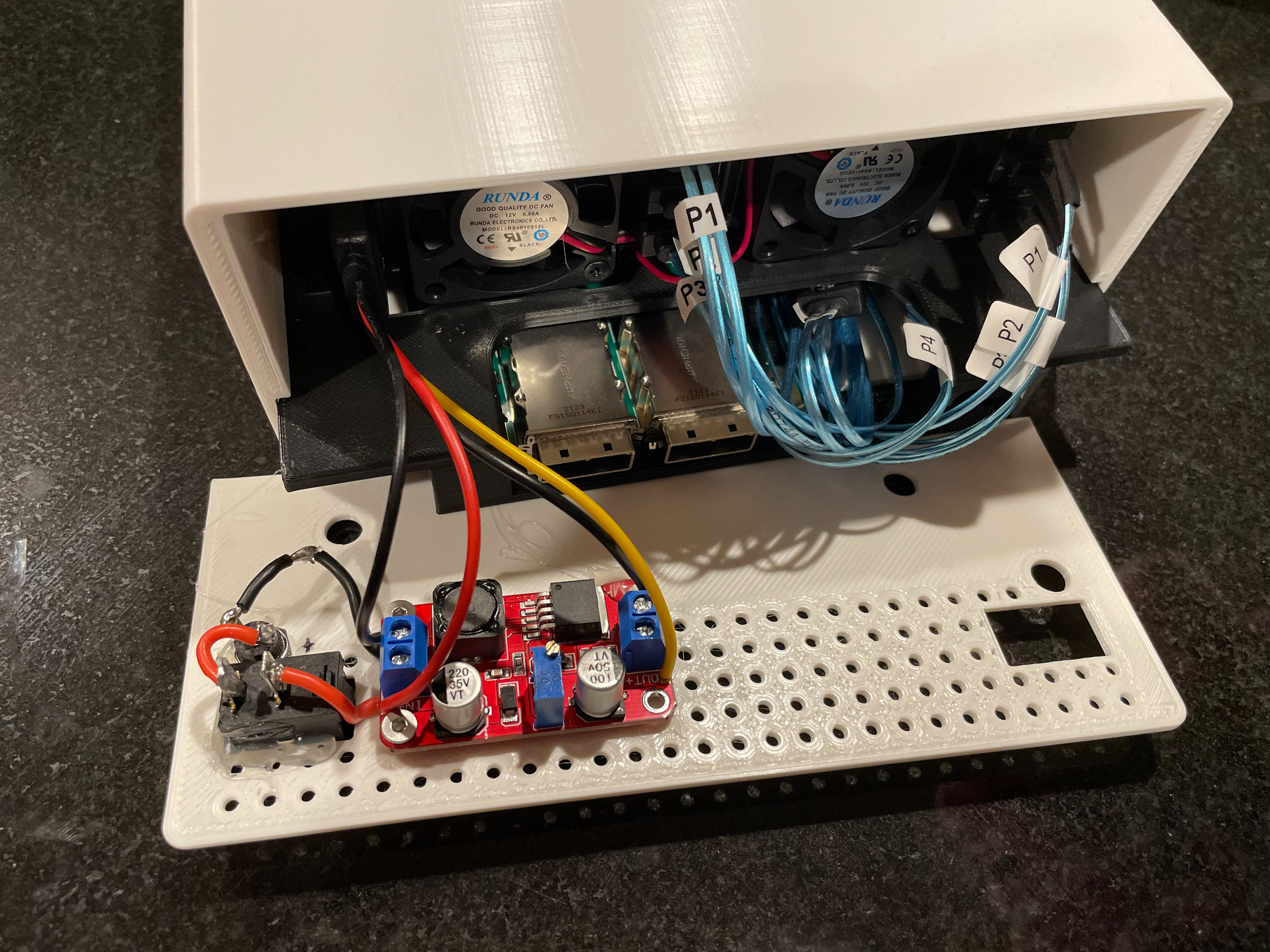
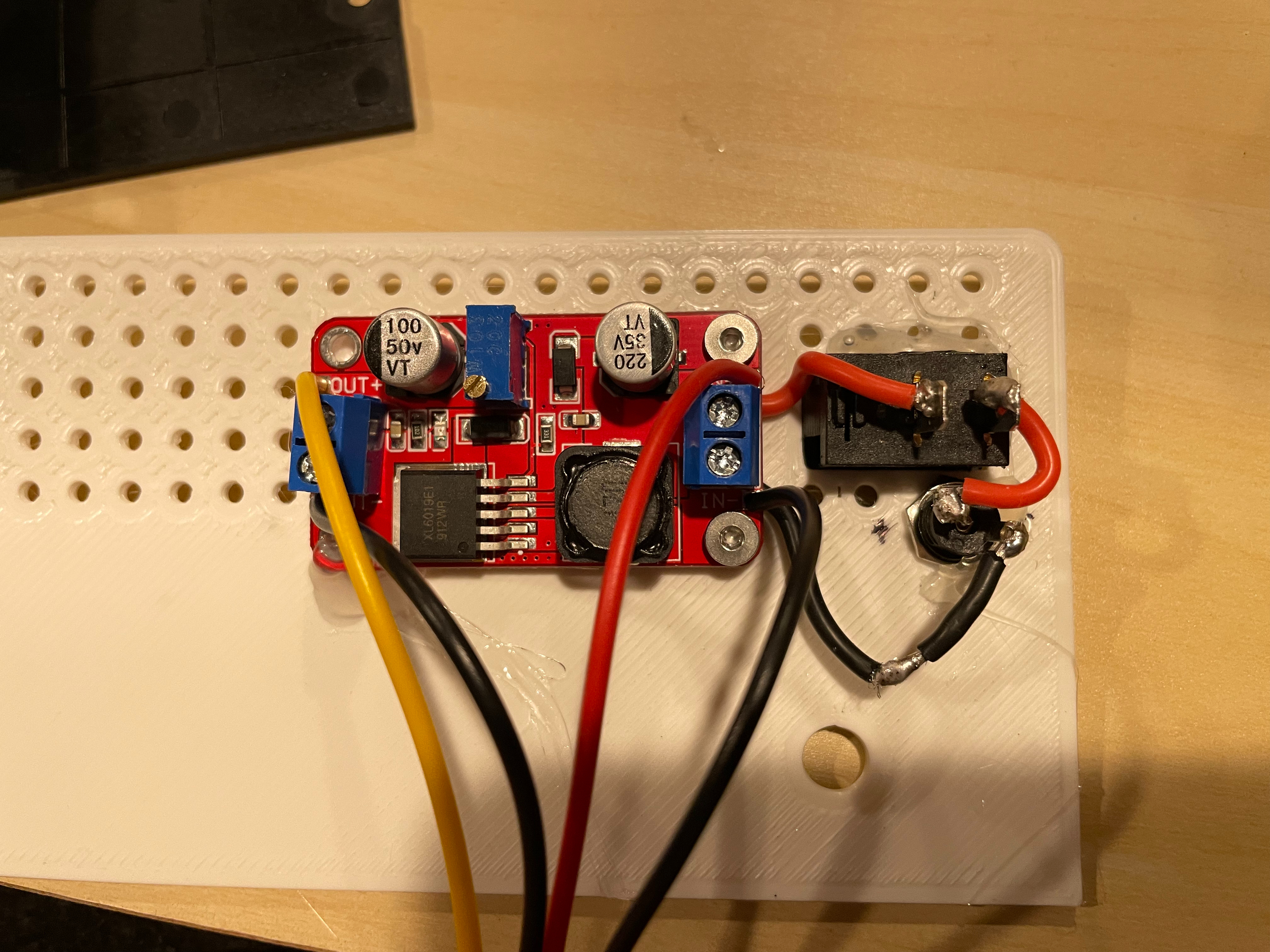
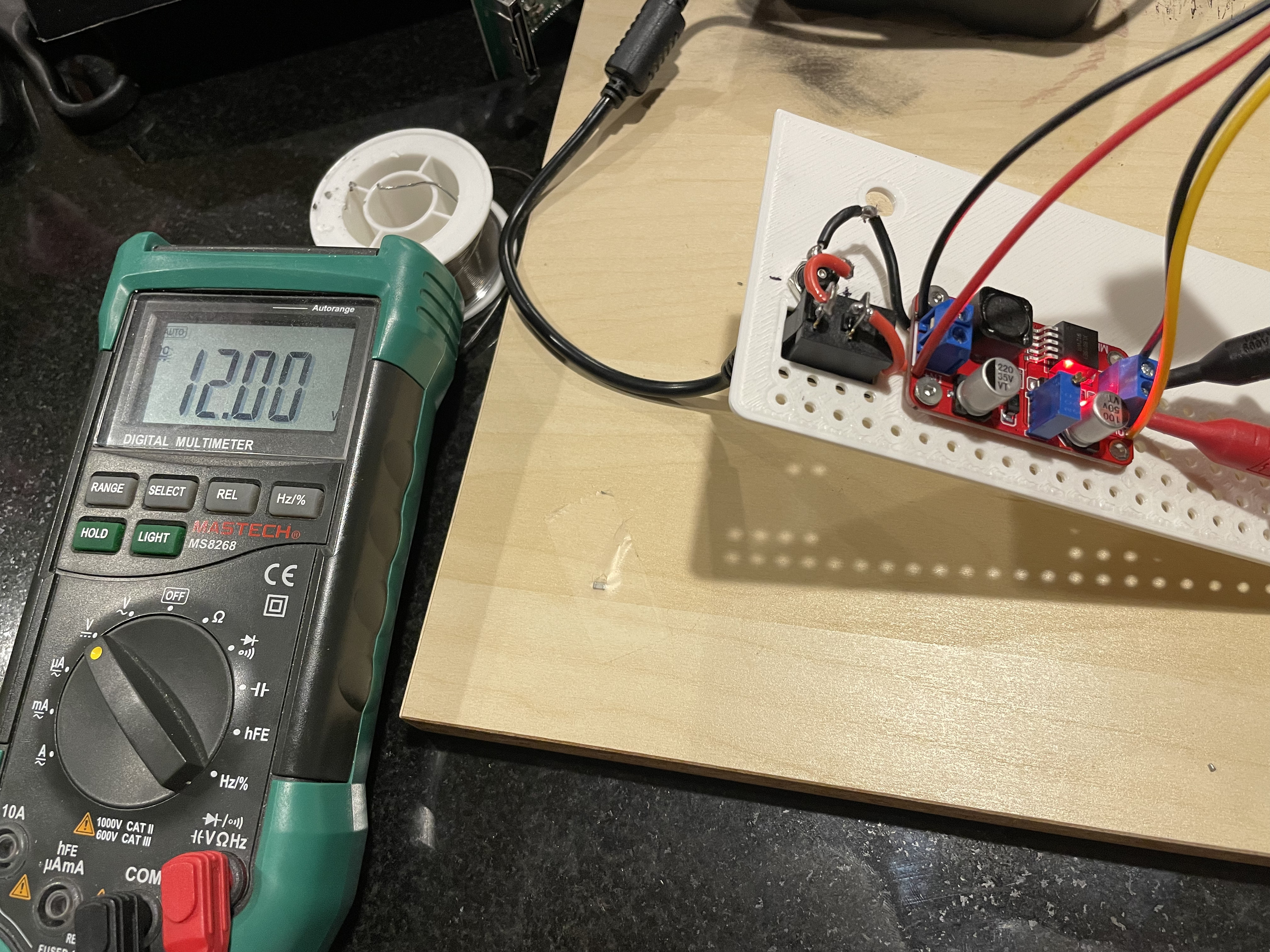
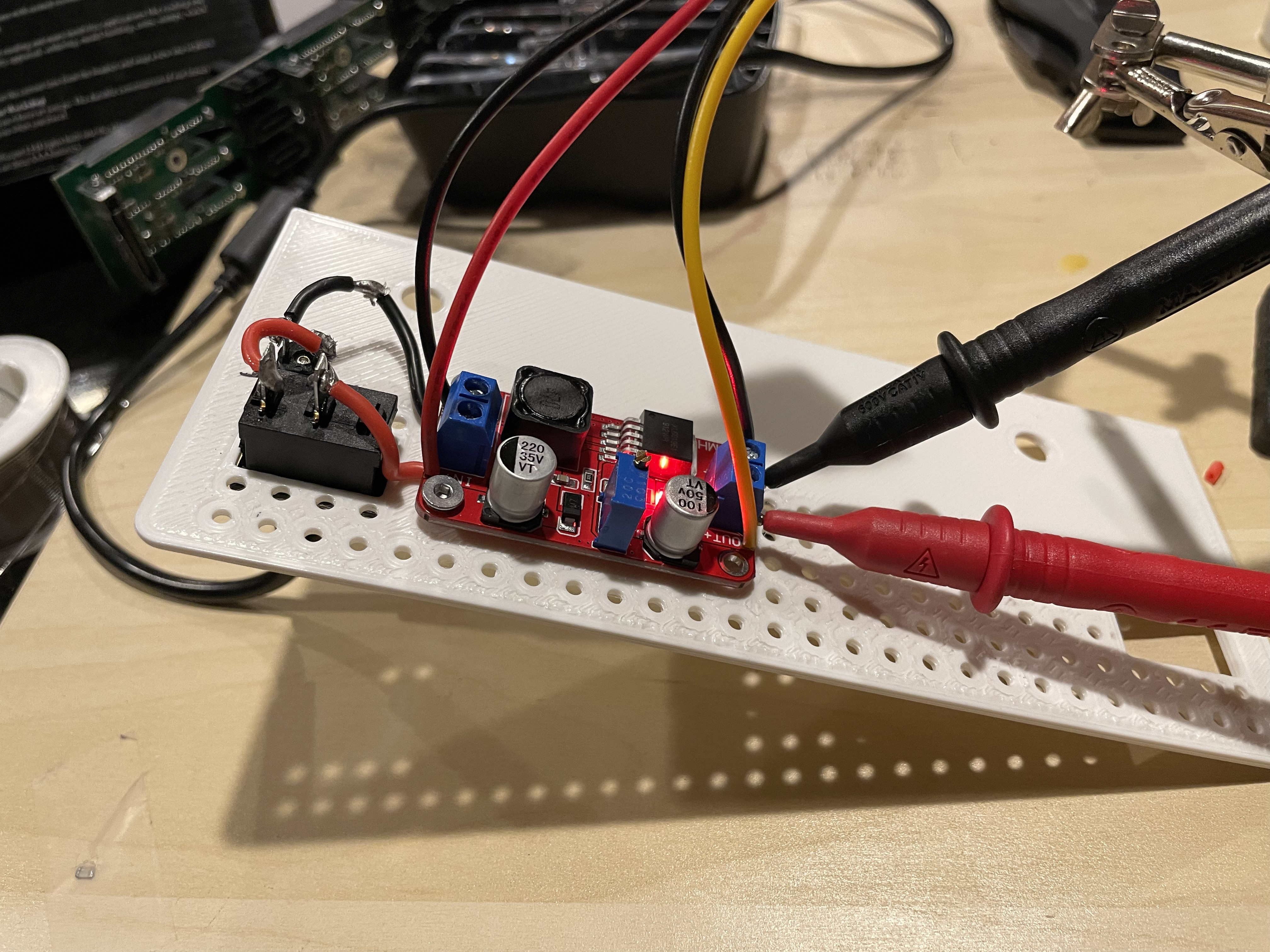
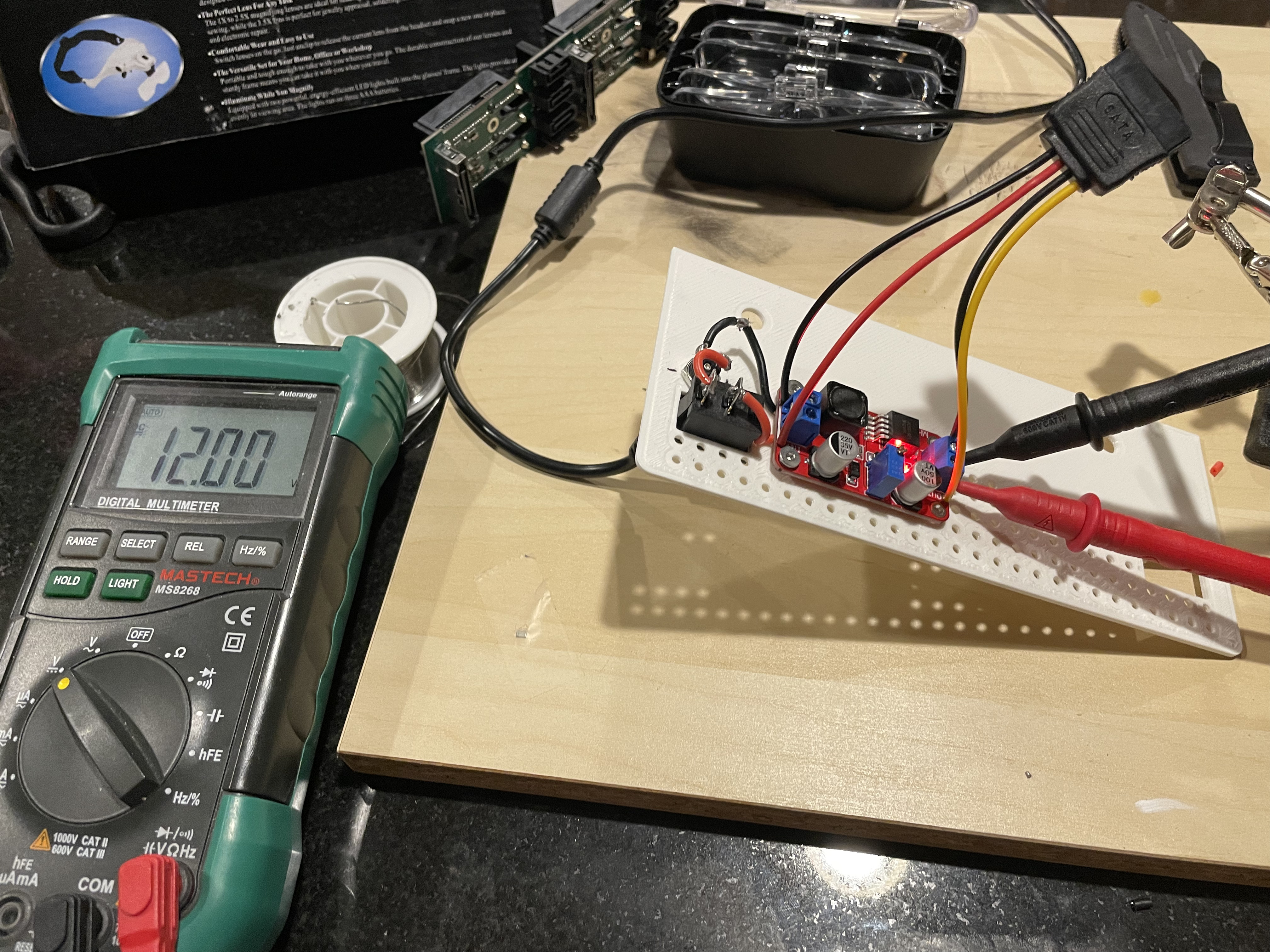
Now I ran into a new problem. The fans for the drive holder ran on the 12 volt line of the SATA cable. The SATA cable only needed 5 volts for the drives but needed 12 volts for the fans. I got a voltage converted and wired it in. I added a switch so the whole unit could be turned off and on.

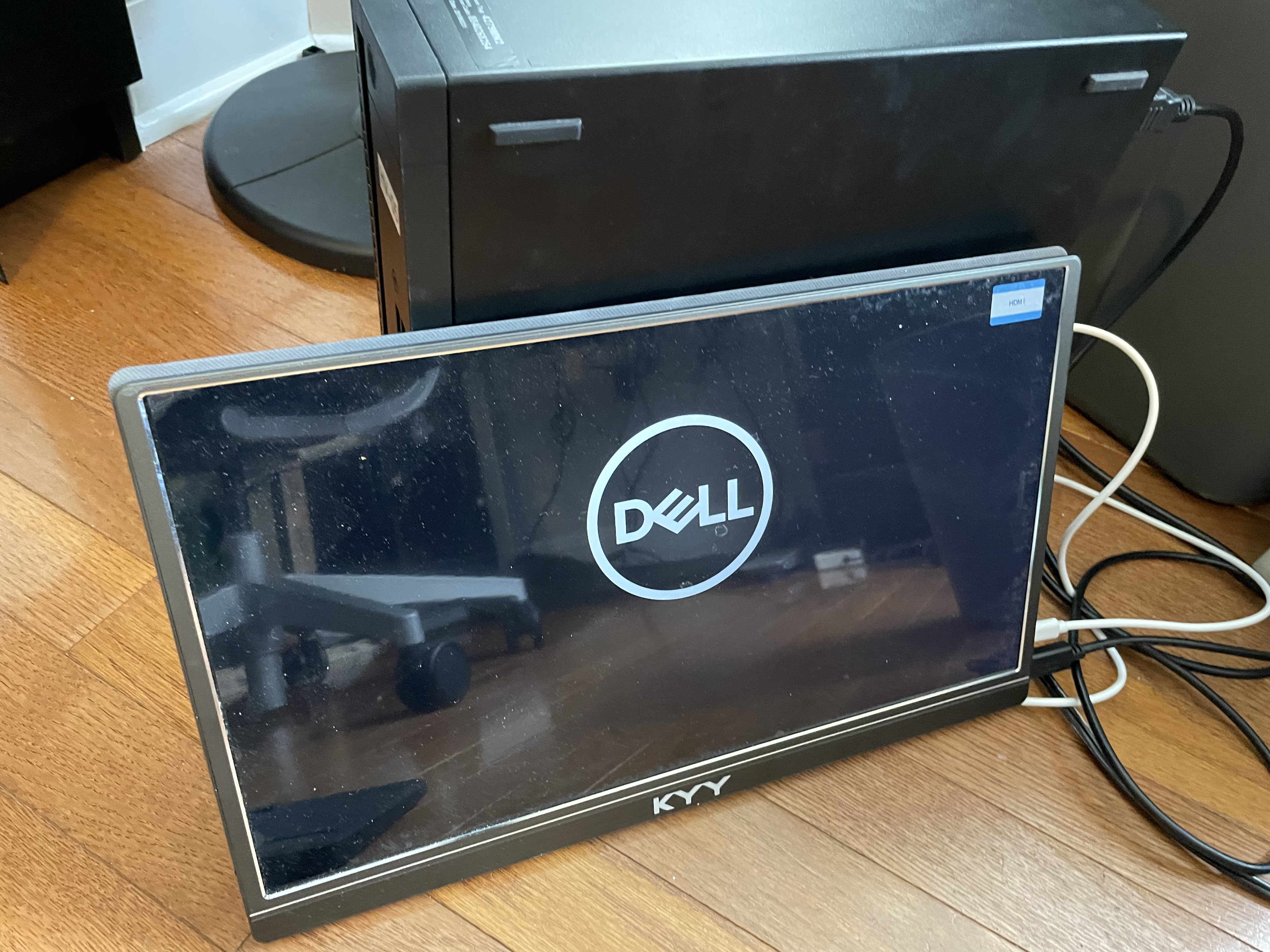
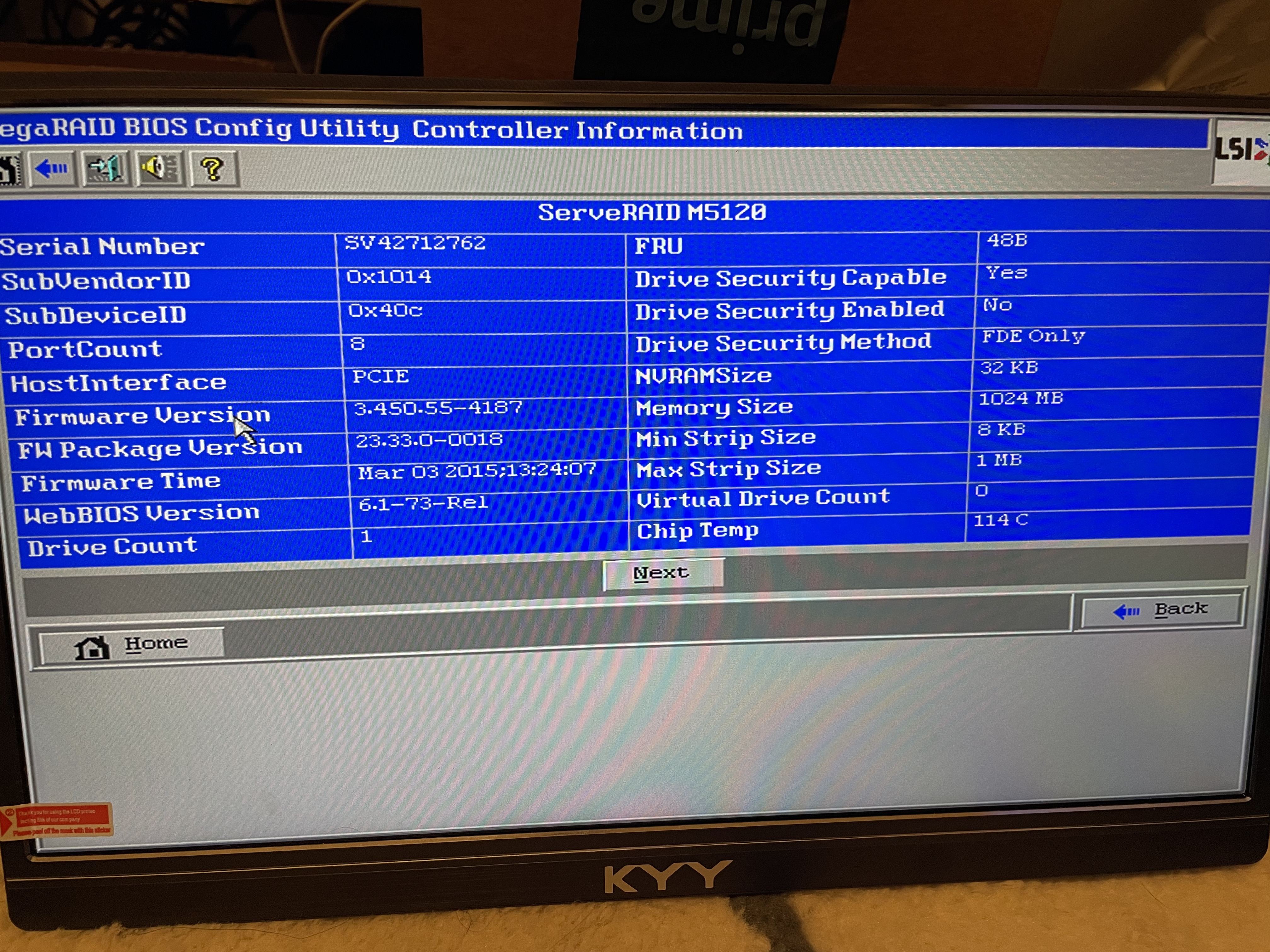
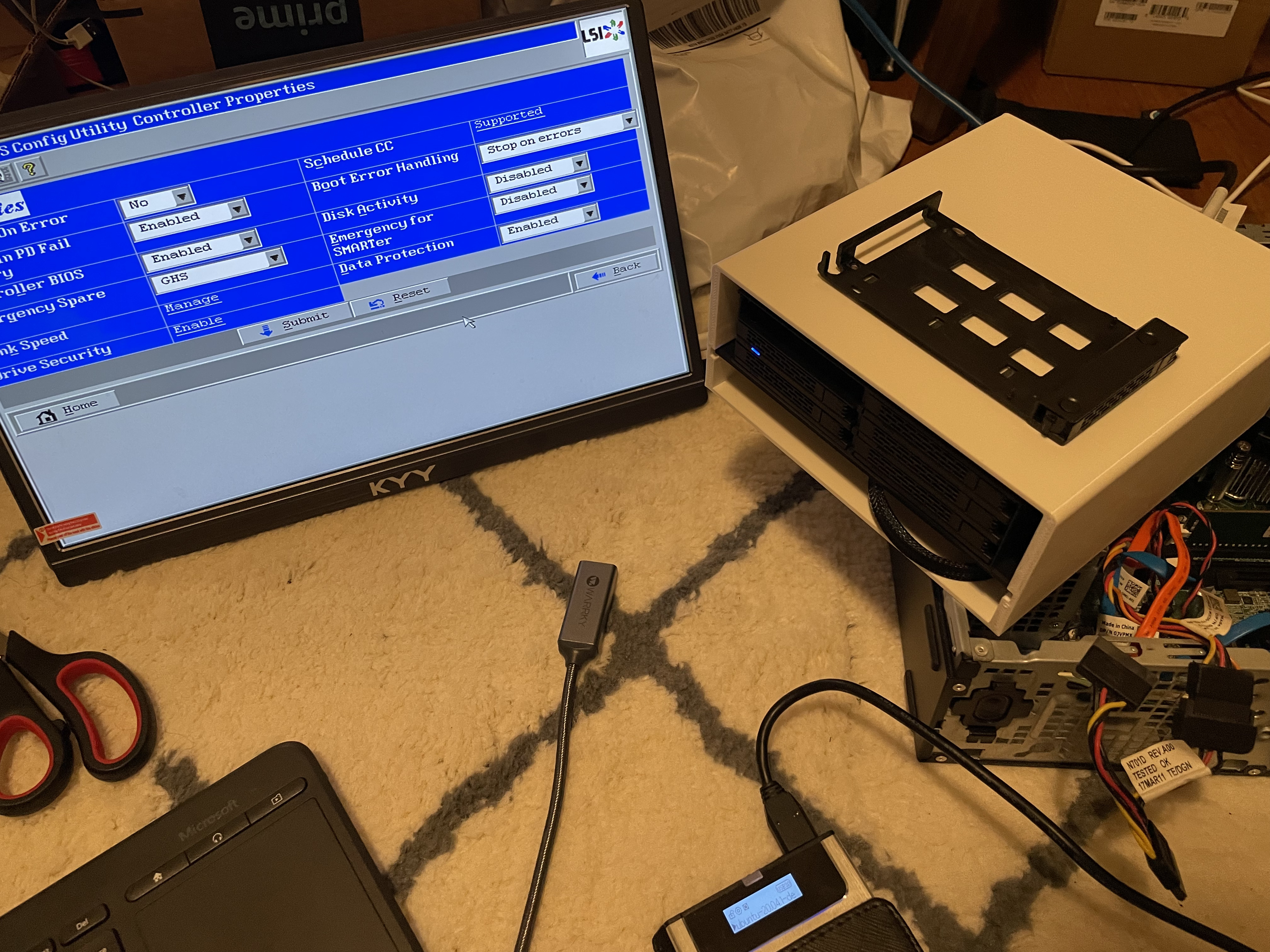
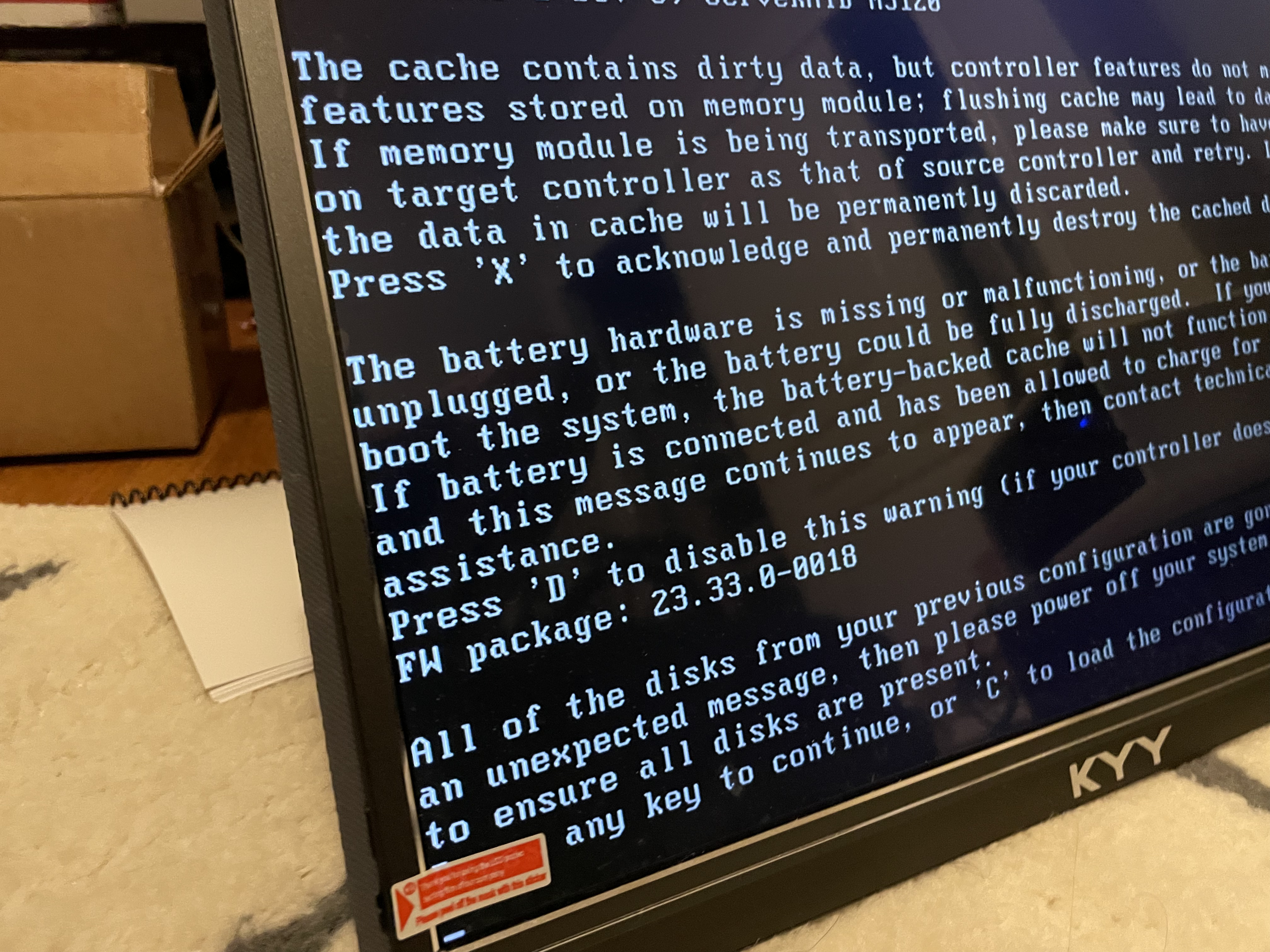
Finally, it is time to add the HBA (not raid controller) to the Dell Optiplex and bring the drives up. This is where everything fell apart. The Optiplexs REALLY didn’t want to start with the HBA controllers. I ordered MANY off ebay to try. Older gen, newer gen, different chipsets… Sometimes they would see SOME of the drives on start-up, sometimes if I bounced the container, then it would see the drives, but there was no consistency. One of the HBAs wouldn’t allow the desktop to boot at all when the card was in. Someone online mentioned, if you put tape over one of the pins on the front of the PCI express connector, the PC won’t be able to read the bus ID it doesn’t understand, and this will allow it to boot. I couldn’t believe when that worked! It still had issues seeing the drives, but interesting none the less.

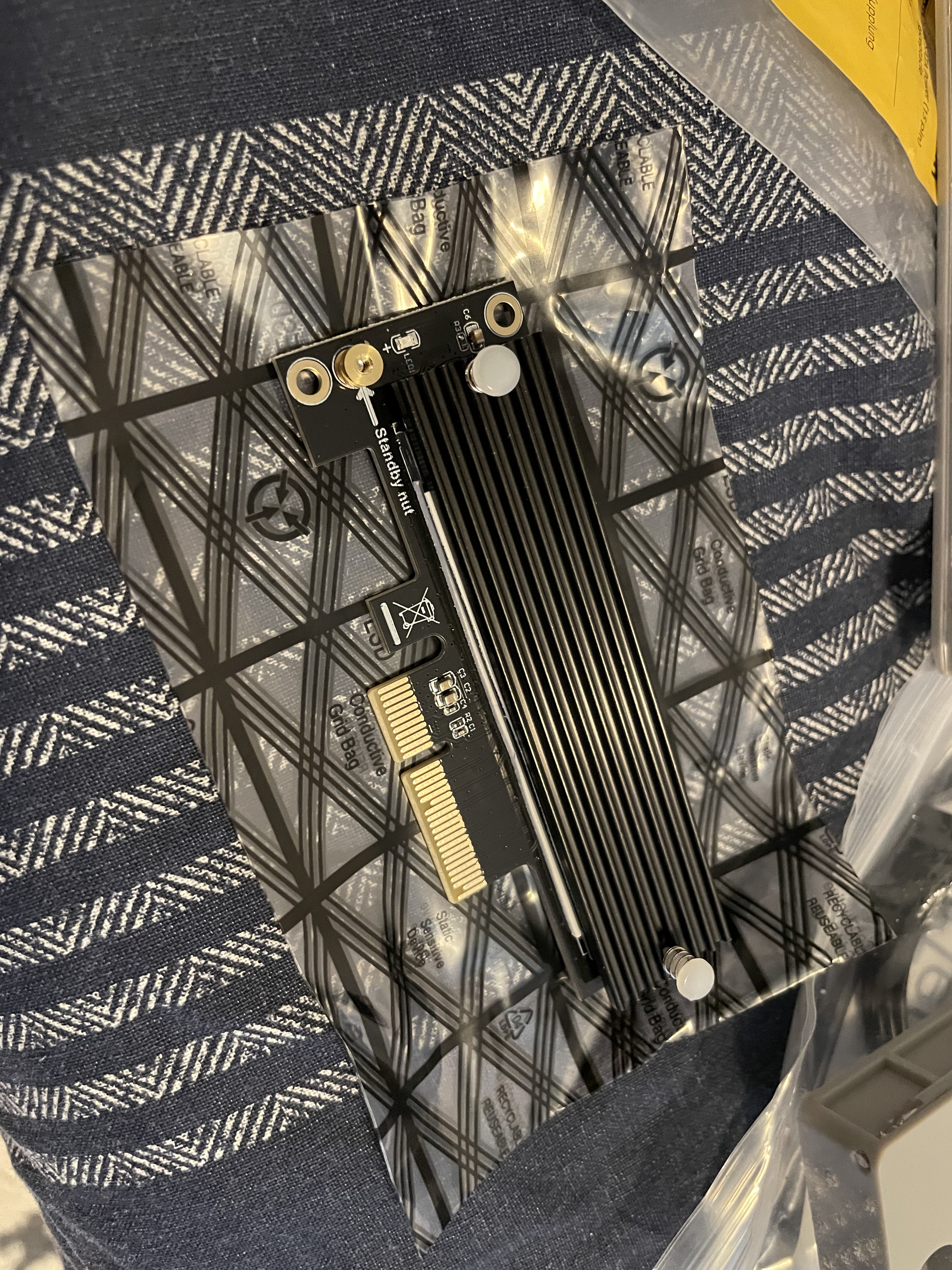
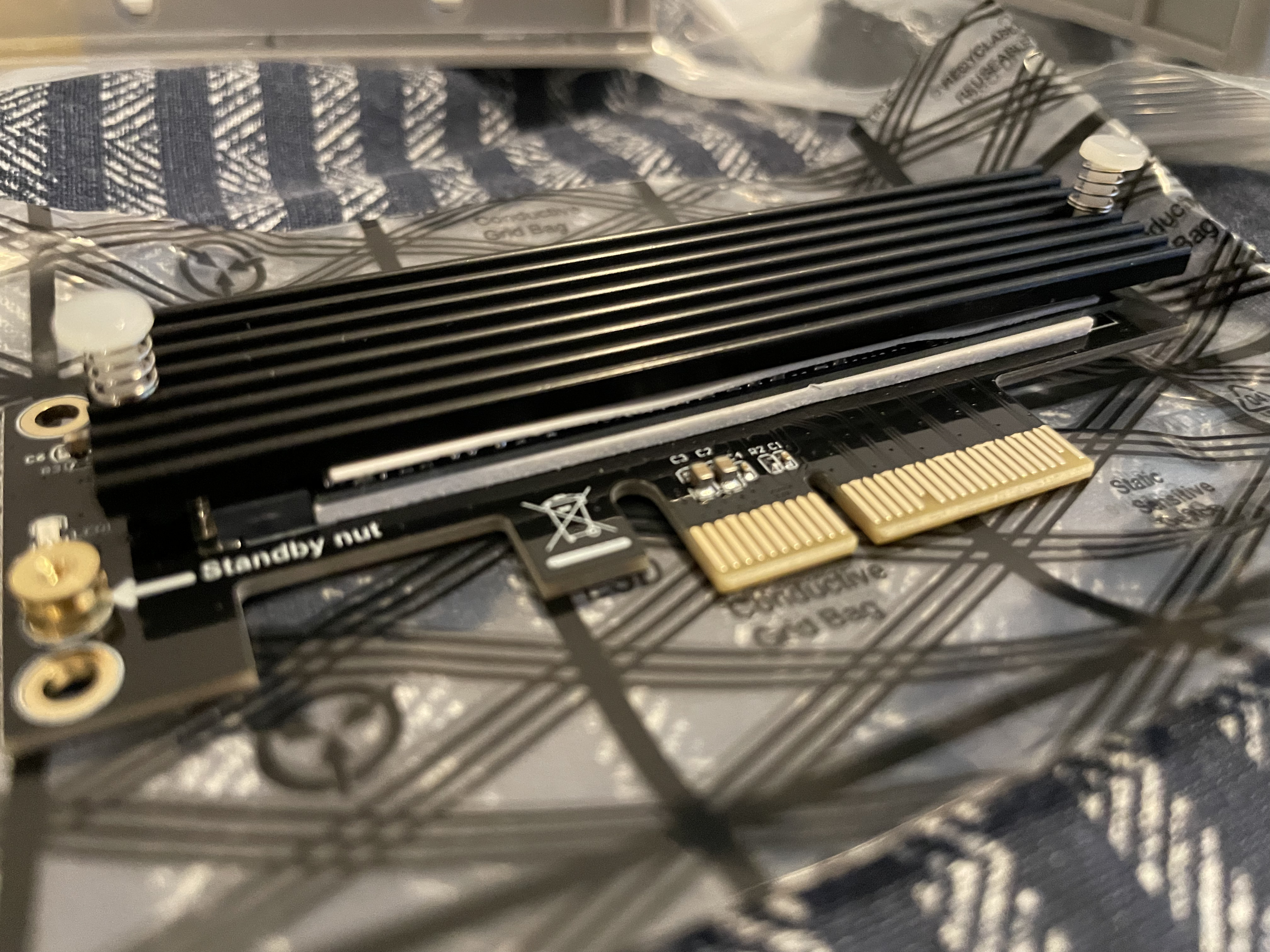
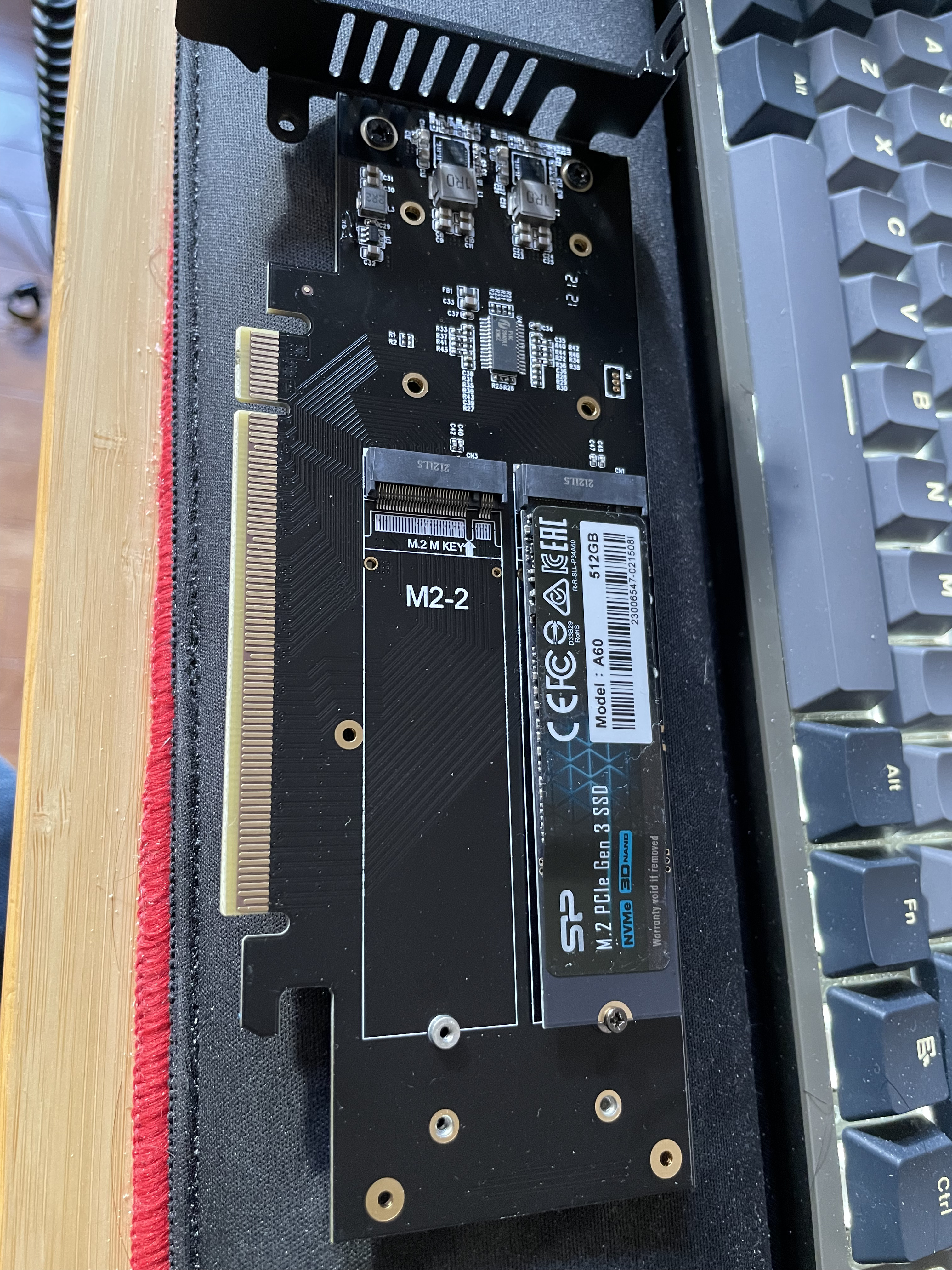
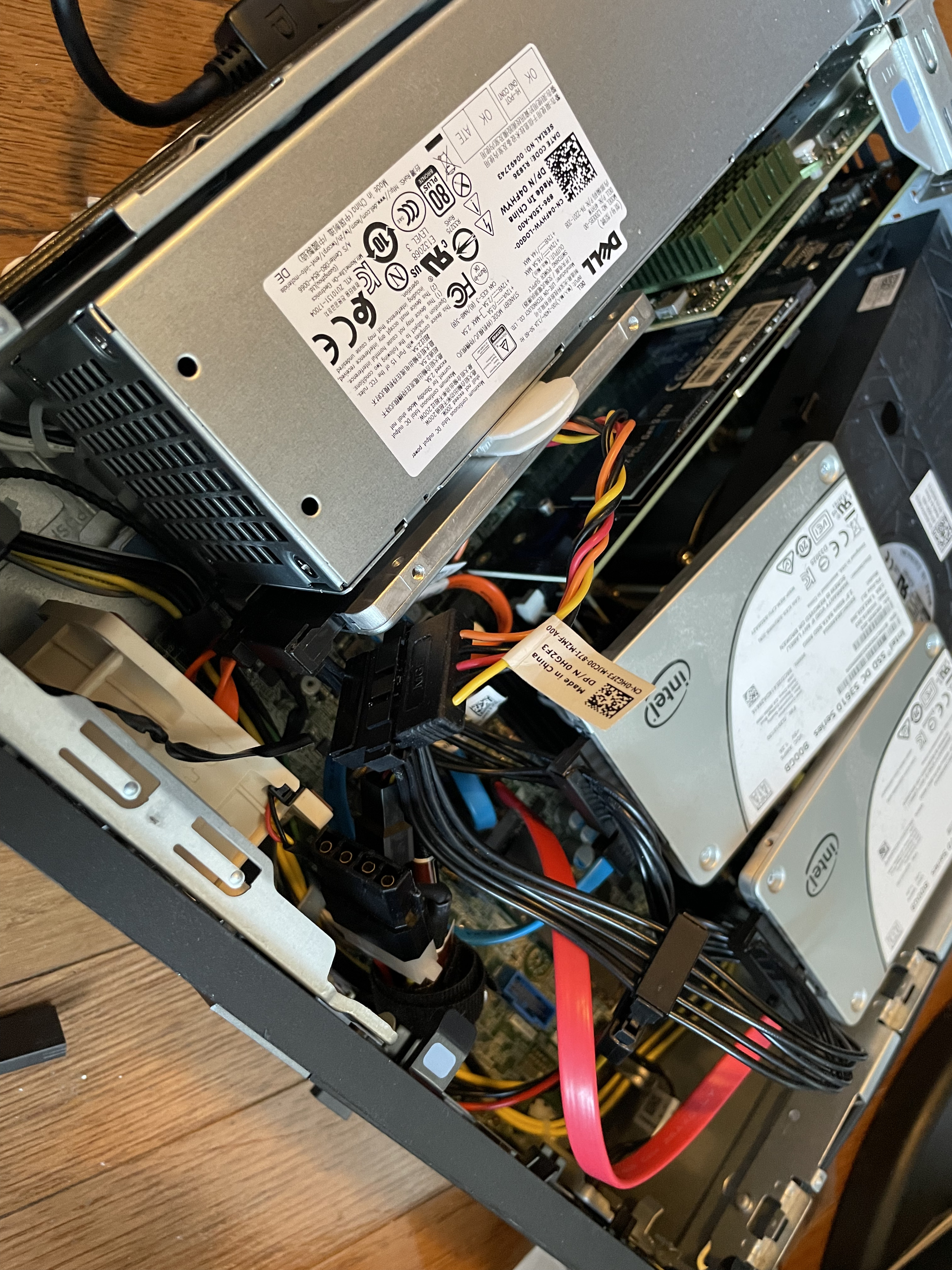
After all of this, I decided it was too much hassle and I wanted something more reliable for the system. I did what I should have done from the start… Used the ports the system already had in the systems… I went from 4 SATA SSDs to 3 SATA SSDS, and 2 NVMe drives. One in the onboard NVMe slot, and another in the PCIe x4 slot that I had. I tried a PCIe card that allows 4 NVMe drives by PCI bifurcation. This is a newer feature which only a few systems support, and these Optiplexs don’t. In either PCIe port. I also want to flag, even though the chipset in these says it supports 128GB of ram, and I can put in 32GB DIMMs and they work fine. The max on the Optiplex 5050 and 5060 is 64GB. I also added a small Noctua fan to the front of the case for additional airflow.

In the end, each of the VMWare nodes has 3 roughly 1TB SSDs, then 2 NVMe drives, one for vSAN cache, one for normal storage. I am booting the nodes off a USB drive in the back, not the most supported config, but has been working well for me. The machines have a dual 10gb nic in the x16 slot, then the secondary NVMe in the x4 slot.

Bypassing “Press Enter for network boot service”

Recently I have been working on some Microsoft SCCM automations. One issue I ran into was when UEFI booting into SCCM I got “Press Enter for network boot service”. Some people said you cant bypass it, others said maybe make it required update. Microsoft’s forums said its part of the firmware, they couldn’t control it; we know that’s wrong, because Linux network boots don’t have this issue and the prompt comes from their efi file.

I wanted to give a quick fix for people who run into this: upgrade your Windows ADK and WinPE to Windows 11. From my readings, Windows 8 ADK didn’t do this button press requirement, and I thought, I would try the newer ADK for Windows 11 instead of Windows 10 version 2004 (or earlier). The second I installed that Windows ADK and restarted, all of a sudden that prompt was gone. Happy booting!

VMWare EAM Failing, and not Allowing Upgrades

I was attempting to upgrade my homelab which I pushed to VMWare vSphere 8.0 because of… YOLO… and after a recent 8.0.1 update I was no longer able to upgrade individual ESXi hosts. I had already updated vCenter to the latest version, now I wanted to upgrade the hosts. That is my normal course of action, vCenter, then hosts; as recommended. When I went to upgrade the hosts I was told:

"Health check fails to retrieve data about service 'vSphere ESX Agent Manager' on '3 Node And Friends'. Verify that the service 'vSphere ESX Agent Manager' is running and try again."

This had me SSH into the appliance and looking at logs. (To quickly mention EAM = “vSphere ESX Agent Manager“) Here are some of the fun errors I was getting in “/var/vmware/eam/eam.log”:

  • “Re-login to vCenter because method: currentTime of managed object: null::ServiceInstance:ServiceInstance failed due to expired client session: null”
  • “failed to authenticate extension com.vmware.vim.eam to vCenter”

Some older guides mentioned unregistering EAM and then re-registering it. This broke my install even worse, and I ended up reverting to a snapshot. (Always snapshot before upgrades…) When I reverted back to before the vCenter upgrade, I realized that EAM was actually failing before the vCenter upgrade; except now I had EAM back in my extension list both on https://vcenter/mob/?moid=ExtensionManager and in vCenter, which was missing after I followed the guide saying to un-register it.

Now that I had the plugin registered, again, I found this KB, and this persons blog very helpful. I ran the recommended commands:

mkdir /certificate

/usr/lib/vmware-vmafd/bin/vecs-cli entry getcert --store vpxd-extension --alias vpxd-extension --output /certificate/vpxd-extension.crt

/usr/lib/vmware-vmafd/bin/vecs-cli entry getkey --store vpxd-extension --alias vpxd-extension --output /certificate/vpxd-extension.key

python /usr/lib/vmware-vpx/scripts/updateExtensionCertInVC.py -e com.vmware.vim.eam -c /certificate/vpxd-extension.crt -k /certificate/vpxd-extension.key -s vcenter.my.domain -u Administrator@vsphere.local

And then EAM suddenly showed happy, and the log started showing useful things:

2023-06-06T16:53:37.573Z |  INFO | vim-monitor | ExtensionSessionRenewer.java | 190 | [Retry:Login:com.vmware.vim.eam:f86509907b4cb7c6] Re-login to vCenter b
ecause method: currentTime of managed object: null::ServiceInstance:ServiceInstance failed due to expired client session: null
2023-06-06T16:53:37.573Z |  INFO | vim-monitor | OpId.java | 37 | [vim:loginExtensionByCertificate:443bbd7c03dce9c6] created from [Retry:Login:com.vmware.vim
.eam:f86509907b4cb7c6]
2023-06-06T16:53:37.947Z |  INFO | vim-async-2 | OpIdLogger.java | 35 | [vim:loginExtensionByCertificate:443bbd7c03dce9c6] Completed.

Thats it! Now I can run updates again! If anyone has the same issue, drop a line in the comments. I hope this isn’t a big new vSphere 8.0 issue. I had upgraded this appliance from 7.0, and perhaps that or a cert issue caused issues.

Below is some of my eam.log to help people:

2023-06-06T02:20:29.728Z | ERROR | vlsi | DispatcherImpl.java | 468 | Internal server error during dispatch
com.vmware.vim.binding.eam.fault.EamServiceNotInitialized: EAM is still loading from database. Please try again later.
        at com.vmware.eam.vmomi.EAMInitRequestFilter.handleBody(EAMInitRequestFilter.java:57) ~[eam-server.jar:?]
        at com.vmware.vim.vmomi.server.impl.DispatcherImpl$SingleRequestDispatcher.handleBody(DispatcherImpl.java:373) [vlsi-server.jar:?]
        at com.vmware.vim.vmomi.server.impl.DispatcherImpl$SingleRequestDispatcher.dispatch(DispatcherImpl.java:290) [vlsi-server.jar:?]
        at com.vmware.vim.vmomi.server.impl.DispatcherImpl.dispatch(DispatcherImpl.java:246) [vlsi-server.jar:?]
        at com.vmware.vim.vmomi.server.http.impl.CorrelationDispatcherTask.run(CorrelationDispatcherTask.java:58) [vlsi-server.jar:?]
        at java.util.concurrent.ThreadPoolExecutor.runWorker(ThreadPoolExecutor.java:1149) [?:1.8.0_362]
        at java.util.concurrent.ThreadPoolExecutor$Worker.run(ThreadPoolExecutor.java:624) [?:1.8.0_362]
        at java.lang.Thread.run(Thread.java:750) [?:1.8.0_362]
2023-06-06T02:20:31.769Z |  INFO | vim-monitor | ExtensionSessionRenewer.java | 190 | [Retry:Login:com.vmware.vim.eam:9ae94019eb8cb9a2] Re-login to vCenter b
ecause method: currentTime of managed object: null::ServiceInstance:ServiceInstance failed due to expired client session: null
2023-06-06T02:20:31.769Z |  INFO | vim-monitor | OpId.java | 37 | [vim:loginExtensionByCertificate:b63ca4cf0b995a54] created from [Retry:Login:com.vmware.vim
.eam:9ae94019eb8cb9a2]
2023-06-06T02:20:34.775Z |  INFO | vim-async-2 | OpIdLogger.java | 43 | [vim:loginExtensionByCertificate:b63ca4cf0b995a54] Failed.
2023-06-06T02:20:34.775Z |  WARN | vim-async-2 | ExtensionSessionRenewer.java | 227 | [Retry:Login:com.vmware.vim.eam:9ae94019eb8cb9a2] Re-login failed, due
to:
com.vmware.eam.security.NotAuthenticated: Failed to authenticate extension com.vmware.vim.eam to vCenter.
        at com.vmware.eam.vim.security.impl.SessionManager.convertLoginException(SessionManager.java:329) ~[eam-server.jar:?]
        at com.vmware.eam.vim.security.impl.SessionManager.lambda$loginExtension$4(SessionManager.java:154) ~[eam-server.jar:?]
        at com.vmware.eam.async.remote.Completion.onError(Completion.java:86) [eam-server.jar:?]
        at com.vmware.eam.vmomi.async.FutureAdapter.setException(FutureAdapter.java:81) [eam-server.jar:?]
        at com.vmware.vim.vmomi.client.common.impl.MethodInvocationHandlerImpl$ClientFutureAdapter.setException(MethodInvocationHandlerImpl.java:731) [vlsi-c
lient.jar:?]
        at com.vmware.vim.vmomi.client.common.impl.MethodInvocationHandlerImpl$RetryingFuture.fail(MethodInvocationHandlerImpl.java:578) [vlsi-client.jar:?]
        at com.vmware.vim.vmomi.client.common.impl.MethodInvocationHandlerImpl$RetryingFuture$RetryActionImpl.proceed(MethodInvocationHandlerImpl.java:625) [
vlsi-client.jar:?]
        at com.vmware.eam.vim.security.impl.ExtensionSessionRenewer.retry(ExtensionSessionRenewer.java:149) [eam-server.jar:?]
        at com.vmware.vim.vmomi.client.common.impl.MethodInvocationHandlerImpl$RetryingFuture.setException(MethodInvocationHandlerImpl.java:541) [vlsi-client
.jar:?]
        at com.vmware.vim.vmomi.client.common.impl.ResponseImpl.setResponse(ResponseImpl.java:239) [vlsi-client.jar:?]
        at com.vmware.vim.vmomi.client.http.impl.HttpExchangeBase.parseResponse(HttpExchangeBase.java:286) [vlsi-client.jar:?]
        at com.vmware.vim.vmomi.client.http.impl.HttpExchange.invokeWithinScope(HttpExchange.java:54) [vlsi-client.jar:?]
        at com.vmware.vim.vmomi.client.http.impl.TracingScopedRunnable.run(TracingScopedRunnable.java:24) [vlsi-client.jar:?]
        at com.vmware.vim.vmomi.client.http.impl.HttpExchangeBase.run(HttpExchangeBase.java:60) [vlsi-client.jar:?]
        at java.util.concurrent.ThreadPoolExecutor.runWorker(ThreadPoolExecutor.java:1149) [?:1.8.0_362]
        at java.util.concurrent.ThreadPoolExecutor$Worker.run(ThreadPoolExecutor.java:624) [?:1.8.0_362]
        at java.lang.Thread.run(Thread.java:750) [?:1.8.0_362]
Caused by: com.vmware.vim.binding.vim.fault.InvalidLogin: Cannot complete login due to an incorrect user name or password.
        at sun.reflect.GeneratedConstructorAccessor58.newInstance(Unknown Source) ~[?:?]
        at sun.reflect.DelegatingConstructorAccessorImpl.newInstance(DelegatingConstructorAccessorImpl.java:45) ~[?:1.8.0_362]
        at java.lang.reflect.Constructor.newInstance(Constructor.java:423) ~[?:1.8.0_362]
        at java.lang.Class.newInstance(Class.java:442) ~[?:1.8.0_362]
        at com.vmware.vim.vmomi.core.types.impl.ComplexTypeImpl.newInstance(ComplexTypeImpl.java:174) ~[vlsi-core.jar:?]
        at com.vmware.vim.vmomi.core.types.impl.DefaultDataObjectFactory.newDataObject(DefaultDataObjectFactory.java:25) ~[vlsi-core.jar:?]
        at com.vmware.vim.vmomi.core.soap.impl.unmarshaller.ComplexStackContext.<init>(ComplexStackContext.java:30) ~[vlsi-core.jar:?]
        at com.vmware.vim.vmomi.core.soap.impl.unmarshaller.UnmarshallerImpl$UnmarshallSoapFaultContext.parse(UnmarshallerImpl.java:167) ~[vlsi-core.jar:?]
        at com.vmware.vim.vmomi.core.soap.impl.unmarshaller.UnmarshallerImpl$UnmarshallSoapFaultContext.unmarshall(UnmarshallerImpl.java:105) ~[vlsi-core.jar
:?]
        at com.vmware.vim.vmomi.core.soap.impl.unmarshaller.UnmarshallerImpl.unmarshalSoapFault(UnmarshallerImpl.java:92) ~[vlsi-core.jar:?]
        at com.vmware.vim.vmomi.core.soap.impl.unmarshaller.UnmarshallerImpl.unmarshalSoapFault(UnmarshallerImpl.java:86) ~[vlsi-core.jar:?]
        at com.vmware.vim.vmomi.client.common.impl.SoapFaultStackContext.setValue(SoapFaultStackContext.java:41) ~[vlsi-client.jar:?]
        at com.vmware.vim.vmomi.client.common.impl.ResponseUnmarshaller.processNextElement(ResponseUnmarshaller.java:127) ~[vlsi-client.jar:?]
        at com.vmware.vim.vmomi.client.common.impl.ResponseUnmarshaller.unmarshal(ResponseUnmarshaller.java:70) ~[vlsi-client.jar:?]
        at com.vmware.vim.vmomi.client.common.impl.ResponseImpl.unmarshalResponse(ResponseImpl.java:284) ~[vlsi-client.jar:?]
        at com.vmware.vim.vmomi.client.common.impl.ResponseImpl.setResponse(ResponseImpl.java:241) ~[vlsi-client.jar:?]
        ... 7 more
2023-06-06T02:20:34.777Z | ERROR | vim-monitor | VcListener.java | 124 | An unexpected error in the changes polling loop
com.vmware.eam.EamRemoteSystemException: Unexpected error communicating with the vCenter server.
        at com.vmware.eam.vim.server.impl.VimRoot.rootOperation(VimRoot.java:106) ~[eam-server.jar:?]
        at com.vmware.eam.vim.server.impl.VimRoot.currentTime(VimRoot.java:78) ~[eam-server.jar:?]
        at com.vmware.eam.vc.VcListener.main(VcListener.java:140) ~[eam-server.jar:?]
        at com.vmware.eam.vc.VcListener.call(VcListener.java:118) [eam-server.jar:?]
        at com.vmware.eam.vc.VcListener.call(VcListener.java:58) [eam-server.jar:?]
        at com.vmware.eam.async.impl.AuditedJob.call(AuditedJob.java:58) [eam-server.jar:?]
        at com.vmware.eam.async.impl.FutureRunnable.run(FutureRunnable.java:55) [eam-server.jar:?]
        at java.util.concurrent.ThreadPoolExecutor.runWorker(ThreadPoolExecutor.java:1149) [?:1.8.0_362]
        at java.util.concurrent.ThreadPoolExecutor$Worker.run(ThreadPoolExecutor.java:624) [?:1.8.0_362]
        at java.lang.Thread.run(Thread.java:750) [?:1.8.0_362]
Caused by: com.vmware.vim.binding.vim.fault.NotAuthenticated: The session is not authenticated.
        at sun.reflect.GeneratedConstructorAccessor57.newInstance(Unknown Source) ~[?:?]
        at sun.reflect.DelegatingConstructorAccessorImpl.newInstance(DelegatingConstructorAccessorImpl.java:45) ~[?:1.8.0_362]
        at java.lang.reflect.Constructor.newInstance(Constructor.java:423) ~[?:1.8.0_362]
        at java.lang.Class.newInstance(Class.java:442) ~[?:1.8.0_362]
        at com.vmware.vim.vmomi.core.types.impl.ComplexTypeImpl.newInstance(ComplexTypeImpl.java:174) ~[vlsi-core.jar:?]
        at com.vmware.vim.vmomi.core.types.impl.DefaultDataObjectFactory.newDataObject(DefaultDataObjectFactory.java:25) ~[vlsi-core.jar:?]
        at com.vmware.vim.vmomi.core.soap.impl.unmarshaller.ComplexStackContext.<init>(ComplexStackContext.java:30) ~[vlsi-core.jar:?]
        at com.vmware.vim.vmomi.core.soap.impl.unmarshaller.UnmarshallerImpl$UnmarshallSoapFaultContext.parse(UnmarshallerImpl.java:167) ~[vlsi-core.jar:?]
        at com.vmware.vim.vmomi.core.soap.impl.unmarshaller.UnmarshallerImpl$UnmarshallSoapFaultContext.unmarshall(UnmarshallerImpl.java:105) ~[vlsi-core.jar
:?]
        at com.vmware.vim.vmomi.core.soap.impl.unmarshaller.UnmarshallerImpl.unmarshalSoapFault(UnmarshallerImpl.java:92) ~[vlsi-core.jar:?]
        at com.vmware.vim.vmomi.core.soap.impl.unmarshaller.UnmarshallerImpl.unmarshalSoapFault(UnmarshallerImpl.java:86) ~[vlsi-core.jar:?]
        at com.vmware.vim.vmomi.client.common.impl.SoapFaultStackContext.setValue(SoapFaultStackContext.java:41) ~[vlsi-client.jar:?]
        at com.vmware.vim.vmomi.client.common.impl.ResponseUnmarshaller.processNextElement(ResponseUnmarshaller.java:127) ~[vlsi-client.jar:?]
        at com.vmware.vim.vmomi.client.common.impl.ResponseUnmarshaller.unmarshal(ResponseUnmarshaller.java:70) ~[vlsi-client.jar:?]
        at com.vmware.vim.vmomi.client.common.impl.ResponseImpl.unmarshalResponse(ResponseImpl.java:284) ~[vlsi-client.jar:?]
        at com.vmware.vim.vmomi.client.common.impl.ResponseImpl.setResponse(ResponseImpl.java:241) ~[vlsi-client.jar:?]
        at com.vmware.vim.vmomi.client.http.impl.HttpExchangeBase.parseResponse(HttpExchangeBase.java:286) ~[vlsi-client.jar:?]
        at com.vmware.vim.vmomi.client.http.impl.HttpExchange.invokeWithinScope(HttpExchange.java:54) ~[vlsi-client.jar:?]
        at com.vmware.vim.vmomi.client.http.impl.TracingScopedRunnable.run(TracingScopedRunnable.java:24) ~[vlsi-client.jar:?]
        at com.vmware.vim.vmomi.client.http.impl.HttpExchangeBase.run(HttpExchangeBase.java:60) ~[vlsi-client.jar:?]
        at com.vmware.vim.vmomi.client.http.impl.HttpProtocolBindingBase.executeRunnable(HttpProtocolBindingBase.java:229) ~[vlsi-client.jar:?]
        at com.vmware.vim.vmomi.client.http.impl.HttpProtocolBindingImpl.send(HttpProtocolBindingImpl.java:114) ~[vlsi-client.jar:?]
        at com.vmware.vim.vmomi.client.common.impl.MethodInvocationHandlerImpl$CallExecutor.sendCall(MethodInvocationHandlerImpl.java:693) ~[vlsi-client.jar:
?]
        at com.vmware.vim.vmomi.client.common.impl.MethodInvocationHandlerImpl$CallExecutor.executeCall(MethodInvocationHandlerImpl.java:674) ~[vlsi-client.j
ar:?]
        at com.vmware.vim.vmomi.client.common.impl.MethodInvocationHandlerImpl.completeCall(MethodInvocationHandlerImpl.java:371) ~[vlsi-client.jar:?]
        at com.vmware.vim.vmomi.client.common.impl.MethodInvocationHandlerImpl.invokeOperation(MethodInvocationHandlerImpl.java:322) ~[vlsi-client.jar:?]
        at com.vmware.vim.vmomi.client.common.impl.MethodInvocationHandlerImpl.invoke(MethodInvocationHandlerImpl.java:195) ~[vlsi-client.jar:?]
        at com.sun.proxy.$Proxy51.currentTime(Unknown Source) ~[?:?]
        at com.vmware.eam.vim.server.impl.VimRoot.rootOperation(VimRoot.java:101) ~[eam-server.jar:?]
        ... 9 more
2023-06-06T02:20:34.778Z |  INFO | vim-monitor | VcListener.java | 125 | Full stack trace: com.vmware.eam.EamRemoteSystemException: Unexpected error communic
ating with the vCenter server.
        at com.vmware.eam.vim.server.impl.VimRoot.rootOperation(VimRoot.java:106)
        at com.vmware.eam.vim.server.impl.VimRoot.currentTime(VimRoot.java:78)
        at com.vmware.eam.vc.VcListener.main(VcListener.java:140)
        at com.vmware.eam.vc.VcListener.call(VcListener.java:118)
        at com.vmware.eam.vc.VcListener.call(VcListener.java:58)
        at com.vmware.eam.async.impl.AuditedJob.call(AuditedJob.java:58)
        at com.vmware.eam.async.impl.FutureRunnable.run(FutureRunnable.java:55)
        at java.util.concurrent.ThreadPoolExecutor.runWorker(ThreadPoolExecutor.java:1149)
        at java.util.concurrent.ThreadPoolExecutor$Worker.run(ThreadPoolExecutor.java:624)
        at java.lang.Thread.run(Thread.java:750)
Caused by: (vim.fault.NotAuthenticated) {
   faultCause = null,
   faultMessage = null,
   object = ManagedObjectReference: type = ServiceInstance, value = ServiceInstance, serverGuid = f0ee8343-1721-4676-9069-1a837625c60b,
   privilegeId = ,
   missingPrivileges = null
}
        at sun.reflect.GeneratedConstructorAccessor57.newInstance(Unknown Source)
        at sun.reflect.DelegatingConstructorAccessorImpl.newInstance(DelegatingConstructorAccessorImpl.java:45)
        at java.lang.reflect.Constructor.newInstance(Constructor.java:423)
        at java.lang.Class.newInstance(Class.java:442)
        at com.vmware.vim.vmomi.core.types.impl.ComplexTypeImpl.newInstance(ComplexTypeImpl.java:174)
        at com.vmware.vim.vmomi.core.types.impl.DefaultDataObjectFactory.newDataObject(DefaultDataObjectFactory.java:25)
        at com.vmware.vim.vmomi.core.soap.impl.unmarshaller.ComplexStackContext.<init>(ComplexStackContext.java:30)
        at com.vmware.vim.vmomi.core.soap.impl.unmarshaller.UnmarshallerImpl$UnmarshallSoapFaultContext.parse(UnmarshallerImpl.java:167)
        at com.vmware.vim.vmomi.core.soap.impl.unmarshaller.UnmarshallerImpl$UnmarshallSoapFaultContext.unmarshall(UnmarshallerImpl.java:105)
        at com.vmware.vim.vmomi.core.soap.impl.unmarshaller.UnmarshallerImpl.unmarshalSoapFault(UnmarshallerImpl.java:92)
        at com.vmware.vim.vmomi.core.soap.impl.unmarshaller.UnmarshallerImpl.unmarshalSoapFault(UnmarshallerImpl.java:86)
        at com.vmware.vim.vmomi.client.common.impl.SoapFaultStackContext.setValue(SoapFaultStackContext.java:41)
        at com.vmware.vim.vmomi.client.common.impl.ResponseUnmarshaller.processNextElement(ResponseUnmarshaller.java:127)
        at com.vmware.vim.vmomi.client.common.impl.ResponseUnmarshaller.unmarshal(ResponseUnmarshaller.java:70)
        at com.vmware.vim.vmomi.client.common.impl.ResponseImpl.unmarshalResponse(ResponseImpl.java:284)
        at com.vmware.vim.vmomi.client.common.impl.ResponseImpl.setResponse(ResponseImpl.java:241)
        at com.vmware.vim.vmomi.client.http.impl.HttpExchangeBase.parseResponse(HttpExchangeBase.java:286)
        at com.vmware.vim.vmomi.client.http.impl.HttpExchange.invokeWithinScope(HttpExchange.java:54)
        at com.vmware.vim.vmomi.client.http.impl.TracingScopedRunnable.run(TracingScopedRunnable.java:24)
        at com.vmware.vim.vmomi.client.http.impl.HttpExchangeBase.run(HttpExchangeBase.java:60)
        at com.vmware.vim.vmomi.client.http.impl.HttpProtocolBindingBase.executeRunnable(HttpProtocolBindingBase.java:229)
        at com.vmware.vim.vmomi.client.http.impl.HttpProtocolBindingImpl.send(HttpProtocolBindingImpl.java:114)
        at com.vmware.vim.vmomi.client.common.impl.MethodInvocationHandlerImpl$CallExecutor.sendCall(MethodInvocationHandlerImpl.java:693)
        at com.vmware.vim.vmomi.client.common.impl.MethodInvocationHandlerImpl$CallExecutor.executeCall(MethodInvocationHandlerImpl.java:674)
        at com.vmware.vim.vmomi.client.common.impl.MethodInvocationHandlerImpl.completeCall(MethodInvocationHandlerImpl.java:371)
        at com.vmware.vim.vmomi.client.common.impl.MethodInvocationHandlerImpl.invokeOperation(MethodInvocationHandlerImpl.java:322)
        at com.vmware.vim.vmomi.client.common.impl.MethodInvocationHandlerImpl.invoke(MethodInvocationHandlerImpl.java:195)
        at com.sun.proxy.$Proxy51.currentTime(Unknown Source)
        at com.vmware.eam.vim.server.impl.VimRoot.rootOperation(VimRoot.java:101)
        ... 9 more

2023-06-06T02:20:34.778Z |  INFO | vim-monitor | VcListener.java | 131 | Retrying in 10 sec.

Moving From Dropwizard to Spring Boot

Where I work historically, we have used Dropwizard, a Java framework for creating web apps a lot. This framework went head-to-head with Spring Boot, in the last few years and has seem to drop out of favor with the community. Nonetheless, I thought for a new project I would dive into using that to get more acquainted with it. After trying to get two of the basic things I needed done, I ended up giving up on Dropwizard and pivoting to Spring Boot instead.

The first big library I tend to use with Java projects, especially web apps, is jOOQ. This framework creates simple objects and gives many ways to interact with your database. The best feature for me is you can have a Gradle plugin scan your database, then create all the objects automatically in Java. Not only does this save you from handwriting a bunch of SQL queries, but it also means when you update the database (probably using something like Flyway), your objects automatically get updated. Now when you compile your program, if you forgot to add that new field somewhere when editing an object, you get a compilation error instead of the application silently failing SQL queries in production.

Dropwizard does not natively support jOOQ, I went looking for a library to add the support I needed. I found benjamin-bader/droptools library. It seemed to do what I needed. I got it wired in, and soon everything was working! I could make objects and with one or two lines edit objects web requests. Wonderful. Then Dropwizard did a major update; version 3.0 was created to keep the javax namespace, and 4.0 was created to move to the jakarta namespace. These versions also moved a bunch of the internals of the Dropwizard libraries around, meaning supporting libraries like droptools would need updated.

That’s when I saw droptools had not been updated for 3 years… I decided I would open a GitHub issue. With not hearing anything for a few days I started tinkering with it. I got a updated build working for Dropwizard 3.0 and did a pull request back to the main repo. In doing this I realized with the Dropwizard 3.0 and 4.0 split, we would need at least 2 versions of the library created at one time. Then on top of that, jOOQ 3.16 was the last to support Java 11, and jOOQ 3.18 was out as the main community supported branch. This means we need to make 4 versions; 2 with Dropwizard 3.0, and 2 with 4.0, then each one having jOOQ 3.16 and 3.18. I rewrite the build pipeline from the Travis CI the repo had to Github actions, and got all 4 versions compiling with some regex to do the edits in the code that were needed. I then used my earlier article, to publish these 4 assets to Maven Central.

This allowed me to update to Dropwizard 4.0, and the Jakarta namespace.

Next, I need to get basic authentication working. My plan is to use Google OAuth as the login mechanism. I do not feel like writing my own for a side project, and out of the ones out there (Google, Facebook, Twitter, Github) I thought it had the most coverage of people, with the least surveillance factor. It is easy enough to get setup with a developer account and get the client-id and secret I needed for OAuth.

Now I had to wire up the OAuth on the application side, this is not too hard I have done this many times with applications at work, but usually there I am using internal libraries. Heading over to the Dropwizard docs didn’t give me exactly what I wanted. They are pretty sparce, and when it comes to setting it up, they mention how to do OAuth but then mention you need to write your own Authenticator and Authorizer for it. I don’t want to do that. I have done that before for servlet-based apps, but this is supposed to be a fun thing, and on the general internet I want a supported auth library. I went searching for an example of how to use the OAuth system. I could not find anything that got me what I wanted.

Then I remembered using Pac4J before with other Java frameworks, this is a security library that has support for many login methods, and many web frameworks. Dropwizard is listed as supported! But the last time it was touched by a human, and not a bot, was over a year ago, and that was just for a small CI fix… I’ll try to get it working anyway!

The dropwizard-pac4j library is what I need, and there is a dropwizard-pac4j-demo which walks you through setting everything up! I get the demo working, I added in Google login support, which wasn’t there by default. Then I spent a day… Where I wanted to get this auth working on Dropwizard 3.0 or 4.0. I don’t want to start working in the older 2.x framework to get stuck later. I downloaded dropwizard-pac4j and the demo locally and started editing them to get the dependencies updated and try to get everything onto the jakarta namespace.

This is where the dependency hell came in. dropwizard-pac4j-demo depends on dropwizard-pac4j, which makes sense. dropwizard-pac4j sets a lot of your project versions based on what it has in it. After updating a ton of dependencies to try to get it to compile it came down to DropwizardTestSupport.java failing to run because it relies on jax-rs-pac4j. jax-rs-pac4j is still in the javax namespace and hasn’t been touched by a human in 6 months or more. This library would need to be updated, because it links directly to the main Jetty Server project which has a dependency on jakarta.servlet.SingleThreadModel in ServletHolder.java, which has been deprecated and removed (discussion), then and I could not get the demo project to load with any combination of dependencies. They all wanted this Jetty 11 file, which should have jakarta.servlet.SingleThreadModel removed, but doesn’t.

I went back and tried to move to Dropwizard 3.0, going back to the javax namespace, but that opened up a bunch of similar issues and a ton of conflicting dependencies in different versions of code dropwizard-pac4j needed. I have my code on GitHub if anyone wanted to continue this journey, or in the future things are in a better place.

With all of that, I thought I would go and check the documentation for Spring Boot. There is a giant page, with in-depth, step by step instructions on how to get Google or GitHub auth working in your app. There is a night and day difference between the support and thoroughness of Dropwizard docs and Spring Boot. With seeing that, I had to decide to change my plans away from Dropwizard. Many on the Java subreddit will debate Spring Boot vs Quarkus; for me, who has only used servlets in the past with embedded Tomcat, I think starting with the popular Spring Boot makes the most sense.